


You’re probably here because the probiotic aisle stopped being simple a long time ago. One bottle promises “digestive balance,” another says “immune support,” and Stonehenge Health Dynamic Biotics stands out by looking more serious than most: higher potency, more strains, added prebiotics, and a lot of enthusiastic customer feedback.
That mix is exactly why stonehenge probiotics reviews are hard to interpret. Products like this can look impressive on paper, get strong consumer praise, and still raise legitimate scientific questions once you inspect the strain list and the kinds of people taking it. A supplement can be well liked and still not be the right fit for a sensitive user.
I approached this the way a gut health researcher would. Not by repeating marketing claims, and not by treating every customer review as proof. The useful question is narrower: who is this formula likely to help, who should be cautious, and what do the actual strain details suggest beyond the label?
Is Stonehenge Probiotics the Right Choice for You
A common buyer scenario looks like this. Someone has intermittent bloating, inconsistent stool pattern, and a supplement history that includes one probiotic that did nothing and another that made symptoms worse within days. A product like Stonehenge Dynamic Biotics is appealing in that context because it promises broad coverage. That same breadth is also the reason it deserves closer scrutiny.
The decision here depends less on whether probiotics are useful in general and more on fit. Stonehenge positions Dynamic Biotics as a synbiotic formula with multiple bacterial strains plus added prebiotic fibers, as noted earlier. On paper, that gives it a wider functional range than a simple single-strain capsule. In practice, wider range also means more variables. That matters if you are comparing marketing claims with customer reviews and trying to predict your own response.
The main question is practical: are you looking for general digestive support, or are you trying to solve a more specific problem such as post-antibiotic disruption, constipation-predominant symptoms, diarrhea tendency, or an IBS pattern linked to food sensitivity?
That distinction changes how this formula should be judged.
A mixed-strain probiotic can make sense for adults with mild, non-specific digestive complaints who want a broad formula and do not usually react strongly to fiber or supplements. It is a less obvious choice for people with highly reactive guts, because the added FOS and inulin can provoke gas and distension in some users before any benefit appears. That pattern often gets flattened in reviews. A five-star comment about “better digestion” does not tell you whether the person had occasional constipation, post-travel irregularity, or clinically significant IBS.
Three screening questions are more useful than star ratings:
- What is your actual target symptom? Evidence in probiotics is strain-specific. A 16-strain product may help with general regularity or digestive comfort, but that is different from having strong evidence for one defined condition.
- How sensitive is your gut to fermentable fibers? If you already notice bloating from chicory root, inulin, garlic, onions, or certain protein bars, the prebiotic side of this formula deserves caution.
- Are you in a higher-caution group? Pregnancy, breastfeeding, childhood use, immune compromise, and major GI disease call for a higher bar than “reviews look good.”
A common limitation of review analysis arises. Customer feedback can signal tolerability trends and perceived benefit, but it rarely separates the effect of the probiotic strains from the effect of the prebiotic fibers, and it almost never addresses whether the formula is appropriate for pregnant women, children, or people with medically complex histories.
Stonehenge Dynamic Biotics may be a reasonable option for the right adult user. It is not a default choice for everyone with gut symptoms. The useful way to evaluate it is strain by strain, use case by use case, and with extra skepticism around the populations that supplement reviews tend to gloss over.
Unpacking the Bottle What Is Stonehenge Dynamic Biotics
You pick up a probiotic because the label looks strong. Then you notice it is not just probiotics. Stonehenge Dynamic Biotics is a synbiotic, meaning it pairs live bacteria with fermentable fibers that can change how the product feels in the gut.
As noted earlier, the formula is presented as a 16-strain probiotic blend with a labeled 55 billion CFUs per serving, plus the prebiotic fibers NutraFlora® FOS and inulin. That combination matters more than the brand language around “digestive support,” because the probiotic portion and the fiber portion can create very different outcomes in different people.
What the numbers actually mean
CFU means colony forming units. It is the labeled amount of live microorganisms in a serving, not proof that every strain is equally useful or equally well studied.
The larger question is formula design. A 16-strain blend gives this product a broad profile, which can appeal to adults looking for general digestive support rather than one highly targeted clinical use. The tradeoff is interpretability. If a user feels better, it is harder to know which strain drove the benefit. If a user gets bloating or cramping, it is also harder to isolate whether the issue came from one bacterial strain, the fiber blend, or the combination.
That distinction is often missing from customer reviews.
Why the prebiotic side deserves equal scrutiny
The fibers in this product are not neutral fillers. FOS and inulin are prebiotics, and prebiotics are rapidly fermented by gut microbes. In some people, that supports stool regularity and helps beneficial bacteria grow. In others, especially people who already react to fermentable carbohydrates, the same mechanism can increase gas, distension, or urgency.
This is one reason synbiotics can produce mixed review patterns. A buyer may credit the “probiotic” for improved regularity when the prebiotic fiber did much of the work. Another buyer may decide the probiotic “didn’t agree with me” when the more likely trigger was the added fermentable fiber. If you want a visual comparison point, this probiotic supplement bottle image helps illustrate how common it is for products in this category to package very different formulas under the same general gut-health label.
What this bottle is actually built to do
Stonehenge Dynamic Biotics is best read as a broad-spectrum digestive support formula. It is designed for consumers who want multiple bacterial species plus prebiotic support in one product, not for someone trying to run a clean self-experiment with one strain at a time.
That makes it a more plausible fit for an adult with mild, nonspecific goals such as regularity or general digestive comfort. It is a less precise choice for someone with a highly reactive gut, someone trying to identify which ingredient helps, or someone evaluating use in groups that need tighter safety and dosing clarity, such as pregnant women and children. Those are exactly the cases where star ratings tend to be least informative and label details matter most.
A Scientific Breakdown of Key Probiotic Strains
A label that says "16 strains and 55 billion CFUs" sounds persuasive until you ask the harder question: which strains, at what evidence level, and for whom? Stonehenge Dynamic Biotics includes several names that microbiome researchers recognize, including Lactobacillus rhamnosus GG, Bifidobacterium lactis BB-12, and Lactobacillus acidophilus NCFM, all inside a larger multi-strain blend.
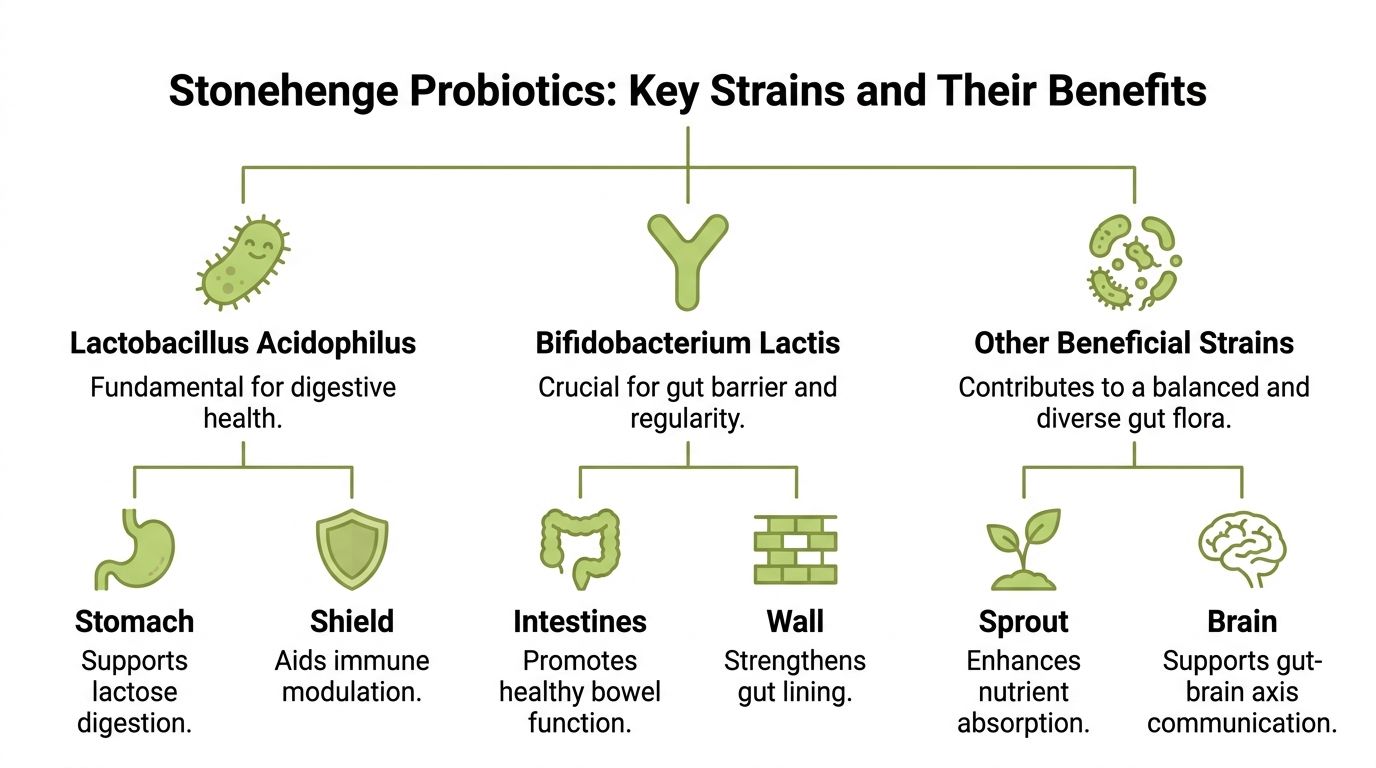
That matters because probiotic evidence is strain-specific. L. rhamnosus GG has one of the better research records for antibiotic-associated diarrhea. B. lactis BB-12 has been studied for bowel regularity and some digestive symptoms. L. acidophilus NCFM appears in trials on gastrointestinal comfort and acute infectious diarrhea. Those are stronger research anchors than the generic species names many supplement labels use.
The catch is that evidence for a strain does not automatically transfer to a finished 16-strain product. Clinical trials usually test a defined organism, dose, and population under controlled conditions. A broad blend changes that setup. Other strains may compete, support each other, or make the practical effect harder to predict, especially in people with IBS-like sensitivity or a history of bloating from fermentable fibers.
The formula also includes NutraFlora® FOS and inulin. That is relevant to how users experience the product, not just how the marketing reads. Prebiotic fibers can improve stool frequency and feed beneficial bacteria, but they are also common triggers for gas and abdominal pressure in people who do poorly with FODMAP-type ingredients.
So the strongest scientific case for Stonehenge is fairly narrow. It is more defensible as a general digestive support product built around a few well-studied strains than as a targeted intervention for one specific condition.
Three practical conclusions follow:
- Studied strains improve credibility, but they do not validate the whole blend for every use case.
- A multi-strain formula can be a poor fit for someone trying to identify one trigger or one helpful ingredient.
- Pregnant women, children, and highly sensitive users need more than a long strain list. They need clearer safety, dosing, and population-specific evidence than most reviews discuss.
That last point is where consumer reviews often miss the mark. A healthy adult looking for modest support with regularity may tolerate this kind of formula well. A parent considering it for a child, or someone evaluating use during pregnancy, should judge it by strain-level evidence and clinician guidance, not by star ratings alone.
For readers comparing labels across broad-spectrum products, this probiotic formula comparison image is a useful reminder that higher strain count does not automatically mean better fit, better evidence, or better tolerability.
Analyzing User Reviews and Expert Critiques
You see a probiotic with strong star ratings, repeated comments about flatter stomachs and better bathroom regularity, and a capsule people say is easy to take. For a healthy adult with mild digestive complaints, that can sound like enough evidence to click Buy Now. For anyone who is pregnant, choosing for a child, or prone to IBS-type flareups, those reviews leave out the questions that matter most.

Public feedback on Stonehenge is mostly favorable. Buyers commonly describe better digestion, less bloating, improved regularity, and higher day-to-day comfort. The verified review summary also notes that Walmart and BBB users often mention digestion and energy benefits, while separate expert commentary raises concerns about side effects and strain selection, including one report involving yeast-infection-like symptoms and one strain flagged as potentially problematic (customer review summary and expert concerns).
Themes that show up in positive reviews
The praise is fairly consistent.
“Working very efficiently.”
That phrase appears in the verified material, and it captures the tone of many favorable reviews. Users also describe the capsules as easy to swallow, without aftertaste, and in some cases easier to tolerate than harsher fiber products or heavily fermented formulas.
A few review patterns matter more than others:
- Regularity support: Many comments focus on smoother bowel movements and less day-to-day digestive friction.
- Bloating relief: Some users report a noticeable drop in fullness or abdominal discomfort after starting the product.
- Simple routine fit: Convenience comes up often, especially among people who dislike powders or strong-tasting supplements.
These reports are useful, but only within limits. Reviews are good at showing what happened for a self-selected group of buyers. They are weak at showing which strain likely drove the effect, whether symptoms would return after stopping, or whether the same formula would suit more sensitive groups.
How a clinician or researcher reads those same reviews
An evidence-based review starts with different filters. Strain identity matters. Dose matters. Population matters. Side-effect patterns matter, especially when a product is marketed broadly but has little population-specific guidance.
Stonehenge becomes harder to judge once you read past the star average. The verified material describes one medical review that rated the product poorly and criticized part of the strain profile, especially LKC 1, which was characterized there as aggressive and capable of crowding out other beneficial bacteria. The same verified material also mentions a user who developed symptoms suggestive of a yeast infection after more than a month of use.
That does not prove the formula is unsafe. It does change how a careful reader should interpret praise. A multi-strain product can help people with mild, nonspecific digestive complaints and still create problems in a subgroup with a more reactive gut, altered vaginal microbiome, recent antibiotic exposure, or a history of supplement intolerance.
Why review averages can mislead
Average ratings compress very different experiences into one number. Someone who wanted modest regularity support and got it may leave five stars after a week. Someone who had delayed side effects, no benefit, or symptom worsening may be a statistical minority but still represent the user group most likely to need caution.
This gap is especially important in populations that are routinely under-discussed in retail feedback. Pregnant women, children, and people with IBS-like symptoms need strain-level safety data and dosing clarity, not broad reassurance from general adult users. If that is your situation, a pregnancy-focused probiotic safety guide is a better starting point than retail testimonials.
A more useful way to read Stonehenge reviews
The strongest reading is narrower and more practical than the marketing spin. Positive customer feedback suggests the product may work reasonably well for some adults seeking general digestive support. Expert criticism suggests the blend deserves more scrutiny than its ratings imply, particularly around controversial strains and side effects that broad review summaries tend to flatten.
For a savvy buyer, the question is not whether the reviews are genuine. Many probably are. The better question is whether the people leaving those reviews resemble you in gut sensitivity, health status, and risk tolerance.
Who Should (and Shouldn't) Take Stonehenge Probiotics
You buy a probiotic because your digestion feels slightly off. You do not have a diagnosed GI disease, but you want less bloating, steadier bowel habits, or fewer “random” stomach days. That is the profile where Stonehenge Dynamic Biotics is easiest to justify. Once you move into pregnancy, childhood use, or a highly reactive gut, the decision shifts from “could this help?” to “is this strain mix appropriate for my risk profile?”
That distinction matters because retail reviews rarely sort users by physiology. They group together healthy adults, people with IBS-like symptoms, and parents buying on behalf of children. For a multi-strain product, those are not interchangeable cases.
Suitability Guide for Stonehenge Probiotics
| User Group | Potential Suitability | Key Considerations |
|---|---|---|
| Generally healthy adult men | Moderate to high | Best fit for basic digestive support, especially if you have tolerated probiotics before |
| Adult women with general bloating concerns | Moderate | Reasonable for gut symptoms. Weak support for hormone-related expectations |
| Pregnant or breastfeeding women | Cautious | No pregnancy-specific clinical evidence for this exact blend in the verified material |
| Children | Low to cautious | No child-specific dosing clarity, and broad adult formulas are harder to judge in pediatric use |
| IBS-prone adults | Mixed | Some strains have relevant evidence, but multi-strain blends can also provoke symptoms |
| Highly sensitive or side-effect-prone users | Cautious | Broader formulas make it harder to identify which ingredient is helping or irritating you |
Generally healthy adults who want broad digestive support
For a healthy adult with mild bloating or inconsistent regularity, Stonehenge is a reasonable trial product. The argument for it is practical, not dramatic. It offers a broad blend that may help if your goal is general gut support rather than treatment of a specific condition.
The better candidate is someone who has used probiotics before without much trouble. A first-time user with a sensitive stomach should be more careful, because a multi-strain formula plus prebiotic support can create more moving parts at once.
More strains also do not automatically mean better results. In probiotic research, outcomes are strain-specific, dose-specific, and problem-specific. A long ingredient list can look impressive while still being imprecise for the symptom you want to improve.
Women considering it for bloating, but not for vague “hormone balance”
Some women buy probiotics for ordinary GI complaints. That use case is defensible. If the goal is less bloating or more regular bowel movements, Stonehenge may be a fair experiment.
The hormone-angle claims need more skepticism. Reviews and marketing language often blur “felt better overall” into “balanced hormones,” but those are very different claims. The verified material does not establish sustained-use evidence for hormone-related benefits, and probiotic studies in this area are still highly strain-dependent.
Pregnancy raises the bar further. A broad adult probiotic should not be treated as interchangeable with a formula evaluated for pregnancy-specific use. If that is your situation, this pregnancy probiotic safety reference for expecting mothers is a better starting point than star ratings.
Pregnant or breastfeeding women
The conservative answer is the right one here. The verified material for Stonehenge does not provide pregnancy-specific trial data for the full formula.
That does not prove the product is unsafe. It means the evidence gap is too large to rely on general customer satisfaction as a substitute for life-stage safety data. Some probiotic strains have acceptable safety records in pregnancy, but safety is not something you can infer cleanly from a brand-level label unless the exact strains, doses, and use context have been evaluated.
Breastfeeding women face a similar issue. General digestive benefit in the average adult does not answer the more important question, which is whether this exact blend is a good fit during a sensitive physiologic period.
Children
Children are a weak fit for this product. The main problem is not that probiotics are inappropriate for kids. The problem is that this is an adult-oriented broad-spectrum formula without clear child-specific dosing in the verified material.
That matters more than many reviews suggest. Pediatric probiotic use works best when the target is narrow, such as antibiotic-associated diarrhea or a specific constipation pattern, and the product has been chosen with age, dose, and strain evidence in mind. A general adult blend makes that judgment harder.
Parents should also care about product handling, storage, and consistency over time. If viability changes across shelf life, the uncertainty is more acceptable in a healthy adult self-experiment than in a child where dosing precision matters more.
For children, a narrower product with pediatric dosing guidance usually makes more sense than a large adult multi-strain blend.
Adults with IBS-like symptoms or very reactive digestion
This is the most nuanced group. Some included strains, such as Bifidobacterium lactis BB-12, have been studied for bowel regularity and digestive comfort, which gives Stonehenge some scientific plausibility for IBS-adjacent complaints. But that does not make the whole formula an IBS product.
People with IBS often respond unevenly to multi-strain supplements. One strain may help stool pattern while another ingredient, including a prebiotic component, can increase gas or abdominal discomfort. That is why broad blends often produce mixed reviews from people with sensitive guts. The product is doing several things at once, and the user cannot easily tell which component is driving the outcome.
If your symptoms are mild, variable, and not strongly triggered by supplements, Stonehenge may be worth a cautious trial. If you already know you react to fibers, fermented products, or changes in routine, a simpler strain-specific option is usually the cleaner choice.
Who should pass
Stonehenge is a poor match for anyone expecting precision from a general formula. That includes pregnant women looking for pregnancy-specific reassurance, parents shopping for a child, and adults with a history of supplement side effects who need a cleaner elimination-style approach.
For those groups, the missing information matters as much as the positive reviews. The safest buying decision is often the one that asks less from guesswork.
Expected Benefits and Potential Side Effects
The fairest way to judge Stonehenge is to hold both sides of the evidence in view at once. The upside is real enough to explain the favorable customer feedback. The downside is real enough that some people should not treat this like a harmless default.
What benefits users commonly report
The verified material tied to Stonehenge consumer reviews highlights recurring reports of:
- Improved regularity
- Reduced bloating
- Better overall gut comfort
- More energy and general wellness in some users
Those outcomes line up with why people usually buy a broad probiotic in the first place. They also make sense given the product design: multiple strains plus prebiotic support. If your digestion is mildly off rather than medically complex, those are the kinds of changes you’d hope to notice first.

The side-effect picture is less simple
The verified analysis also points to concerns that shouldn’t be brushed aside. Professional reviewers flagged at least one strain as potentially problematic, and one reviewer described symptoms suggestive of a yeast infection after extended use in the verified material. That doesn’t mean most users will experience that outcome. It does mean this isn’t a zero-risk wellness product.
Short-term digestive adjustment is also plausible with a formula like this, especially because it combines probiotics with fermentable prebiotic fibers. While some users experience smoother digestion, others may notice more movement in the beginning than they wanted.
A practical way to think about side effects:
- Mild adjustment effects: temporary gas, bloating, or changes in bowel pattern may occur as the gut adapts
- Formula mismatch effects: a broad blend may feel “too much” for highly sensitive users
- Strain-specific concern: expert criticism of the strain mix means tolerance should not be assumed
Start by asking whether you want a strong broad-spectrum experiment or a controlled test. Stonehenge is closer to the first category.
What a realistic expectation looks like
The best-case scenario is not a dramatic transformation. It’s a quieter result: easier bowel regularity, less digestive heaviness, and fewer days where your gut feels unpredictable.
The wrong expectation is that a multi-strain probiotic should improve every gut issue just because the label is impressive. Stonehenge may help the right adult user. It may also expose the limits of broad formulations if your digestion is already fragile.
How to Use Stonehenge Probiotics for Best Results
You start Stonehenge on a Monday, eat differently than usual, sleep badly twice, and add magnesium at the same time. By Friday, you have no idea what caused the change in your digestion. That is the main reason probiotic trials fail in real life. The routine is too noisy to interpret.
Stonehenge is a high-potency, multi-strain formula with added prebiotic fibers, so the best use strategy is controlled testing, not casual use. If you want a clean read on whether it helps, keep the rest of your routine as stable as possible for the first couple of weeks.
Start in a way that gives you usable feedback
Pick one daily time and stick to it. Consistency matters less because probiotics need a perfect clock and more because irregular timing makes your response harder to judge. If your stomach is easily irritated, taking it with food or soon after a meal is a reasonable first move.
Use one target symptom. Bowel regularity is a good option. Bloating works too. Tracking energy, skin, mood, stool pattern, and appetite all at once usually creates more confusion than insight.
A practical setup:
- Choose a stable week: Avoid starting during travel, illness, major diet changes, or unusually high stress.
- Keep timing consistent: Use the same meal or same part of the day so your routine is repeatable.
- Record one main outcome: Write down what changes, when it changes, and whether the shift lasts more than a day or two.
- Wait before adding anything else: New fiber powders, digestive enzymes, or other supplements can muddy the result.
If timing is the part you are unsure about, this visual guide to probiotic timing gives a simple framework for building a routine you can follow.
How long to assess it
Do not judge the product after a single dose. Probiotic response is rarely that clean. What matters is the pattern over time. Look for a repeated change in the symptom you chose to track, not random day-to-day variation.
That also means you should stop if the pattern is clearly negative. Ongoing worsening is useful information. It suggests the formula, dose timing, or prebiotic component may not suit your gut.
Common mistakes that distort the result
Starting Stonehenge alongside several other "gut health" products is the biggest one. Another is changing your diet sharply while trying to assess tolerance. A third is continuing despite obvious intolerance because the label looks scientifically impressive.
The goal is not to force a positive outcome. The goal is to find out, with as little guesswork as possible, whether this specific blend helps your digestion.
The Verdict Is Stonehenge Probiotics Worth It
Pros
- Broad 16-strain formulation with 55 billion CFUs
- Includes NutraFlora® FOS and inulin for synbiotic support
- Contains several strains with recognizable digestive research relevance
- Many users report better digestion, less bloating, and improved energy
Cons
- Expert analysis raises concerns about at least one potentially problematic strain
- Reported experiences vary sharply across users
- Limited clarity for pregnancy, breastfeeding, children, and long-term sensitive use
- Shelf-life viability concerns matter more in family and child-use scenarios
My verdict is nuanced. Stonehenge Dynamic Biotics is most worth considering for a generally healthy adult who wants a high-potency, multi-strain probiotic for broad digestive support and understands that tolerance is highly individual. It is less convincing for pregnant women, parents shopping for children, and highly reactive IBS users who need tighter strain targeting and clearer safety context.
If you want simplicity and predictability, this may feel too complex. If you want a broad-spectrum formula and you’re willing to monitor your response carefully, it has enough evidence-backed features to justify a cautious trial.
If you want more evidence-first probiotic breakdowns, practical gut health guides, and side-by-side comparisons for adults, pregnancy, and kids, visit Healthy Gut Review. It’s a useful place to keep researching before you commit to a formula that may or may not fit your gut.