

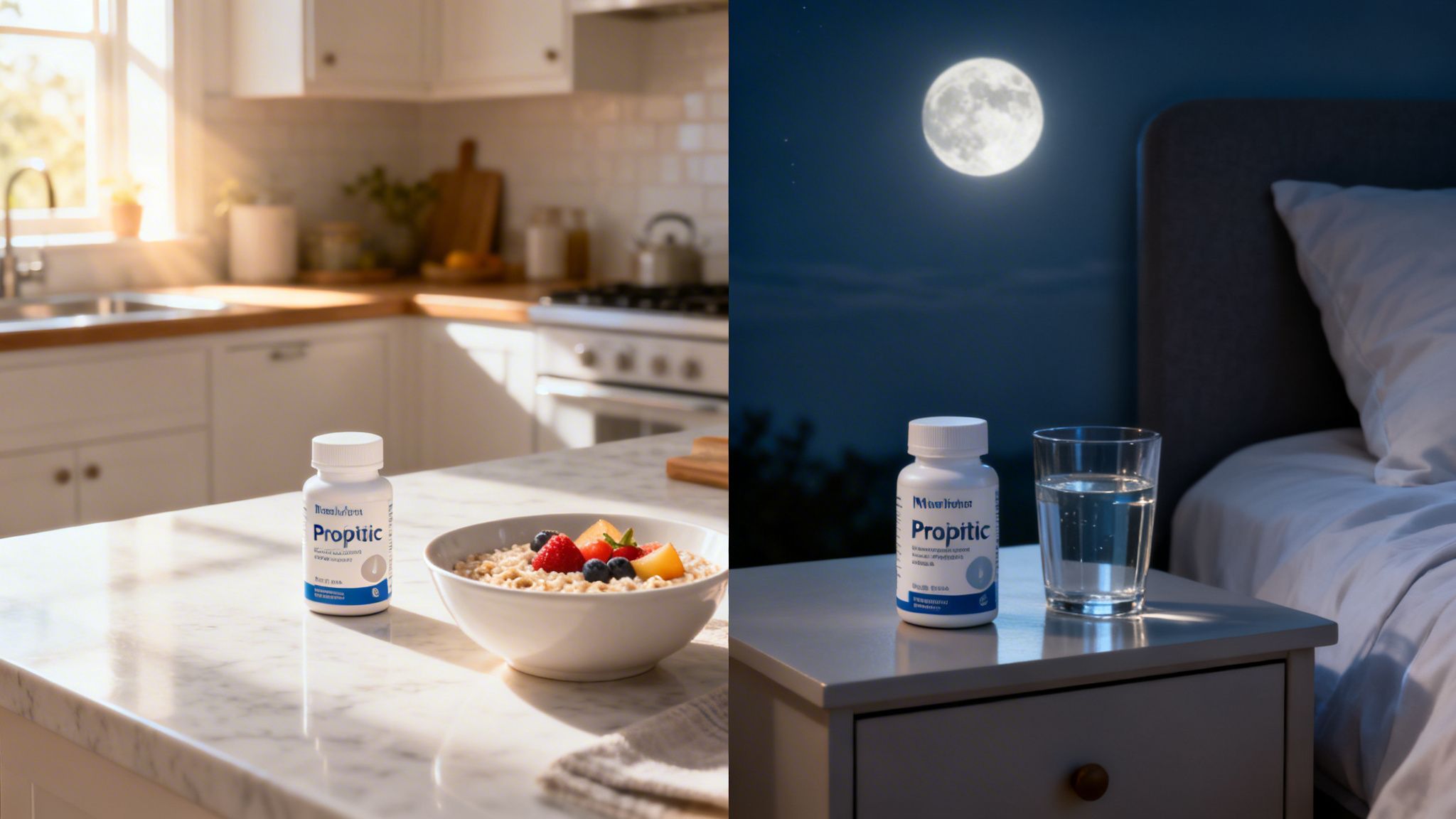
So, you've decided to add probiotics to your daily routine, but you're stuck on two key questions: which product is best, and when is the best time to take it? While consistency is king, a little timing strategy—paired with the right product—can go a long way.
This guide will break down the 7 best probiotics on Amazon, review their pros and cons, and help you decide whether a morning or night routine is your winning ticket to better gut health.
The 7 Best Probiotics to Take Morning or Night
Finding the right probiotic can feel overwhelming. To simplify your search, we’ve researched and compiled the 7 best probiotics available on Amazon, each with unique strengths to fit different needs and preferences.
1. Physician's Choice 60 Billion Probiotic
Best Overall
This powerhouse probiotic is our top pick for its high CFU count, diverse blend of 10 well-researched strains, and inclusion of an organic prebiotic fiber blend. The delayed-release capsules ensure the good bacteria survive stomach acid, making it effective whether you take it morning or night.
User Review: "I've been taking this for about 6 months now. I take it every morning with breakfast. My bloating is gone, and I just feel… better. It's the most effective probiotic I've ever tried." – Jessica P.
Pros:
- High potency with 60 Billion CFUs.
- 10 diverse strains for comprehensive support.
- Includes prebiotics to feed the good bacteria.
- Delayed-release capsules for maximum survival.
Cons:
- Higher CFU count might be too intense for absolute beginners.
2. Garden of Life Dr. Formulated Probiotics for Women
Best for Women's Health
Specifically designed by Dr. David Perlmutter, this probiotic targets women's specific health needs. It combines 16 probiotic strains with a focus on vaginal and immune health, all packed into a once-daily, shelf-stable capsule.
Pros:
- Formulated for women's digestive, vaginal, and immune health.
- Contains 16 diverse probiotic strains.
- Shelf-stable, no refrigeration required.
- Reputable brand with a focus on clean ingredients.
Cons:
- Not a delayed-release capsule, so best taken with food.
3. Culturelle Digestive Daily Probiotic
Best for Sensitive Stomachs
If you're new to probiotics or have a sensitive system, Culturelle is a fantastic starting point. It features Lactobacillus rhamnosus GG (LGG), one of the most clinically studied strains in the world, known for being gentle yet effective at reducing occasional gas, bloating, and diarrhea.
Quote from a Health Expert: "For individuals prone to digestive upset when starting a new supplement, a single-strain probiotic like Culturelle's LGG is ideal. Taking it at night can further minimize potential side effects as the body adjusts." – Dr. Anya Sharma, Gastroenterologist.
Pros:
- Features the highly-researched LGG strain.
- Gentle and well-tolerated by most people.
- Clinically proven to support digestive health.
- Easy one-capsule-a-day dose.
Cons:
- Only contains a single strain, which may not be sufficient for more complex gut issues.
4. Align Probiotic 24/7 Digestive Support
Best Gastroenterologist-Recommended Brand
Align is the #1 gastroenterologist-recommended probiotic brand for a reason. It contains the patented strain Bifidobacterium 35624, which helps fortify your digestive system with good bacteria and is clinically proven to help with occasional abdominal discomfort, gas, and bloating.
Pros:
- Top doctor-recommended brand.
- Contains a unique, patented strain.
- Clinically proven to relieve symptoms of occasional IBS.
- Individually sealed capsules for potency.
Cons:
- Premium price point compared to other options.
- Single-strain formula.
5. Renew Life Women's Probiotic 50 Billion CFU
Best High-Potency for Women
This is another excellent choice for women, offering a potent 50 billion CFUs from 12 diverse strains, including the #1 most studied strain, LGG. It's formulated to support both digestive and vaginal health and uses delayed-release capsules to ensure the probiotics reach your gut alive.
Pros:
- High potency with 50 billion CFUs.
- 12 strains tailored for women's health.
- Delayed-release capsules for better survival.
- Supports both urinary and digestive health.
Cons:
- Requires refrigeration after opening to maintain potency.
6. MaryRuth's Liquid Probiotic
Best Liquid Probiotic for the Whole Family
For those who can't or prefer not to swallow pills, MaryRuth's Liquid Probiotic is a game-changer. It's plant-based, raw, and sourced directly from mother nature. This unflavored liquid can be easily added to water, juice, or a smoothie, making it perfect for kids and adults alike.
User Review: "My kids won't take pills, but they don't even notice this in their morning juice. It's made a huge difference in their regularity. I love that it's gentle and I can take it too." – David K.
Pros:
- Excellent for children and adults who dislike pills.
- Unflavored and easy to mix into drinks.
- Vegan, non-GMO, and shelf-stable.
- Contains 12 different probiotic strains.
Cons:
- CFU count is not standardized per serving like capsules.
- Some users dislike the "earthy" taste when taken alone.
7. Seed DS-01® Daily Synbiotic
Best for Science-Backed Formulation
Seed is a "synbiotic," meaning it contains both probiotics and prebiotics. Its standout feature is the ViaCap® 2-in-1 capsule technology—a prebiotic outer capsule and a probiotic inner capsule. This ensures the probiotics bypass stomach acid, bile salts, and digestive enzymes to be delivered alive to your colon. It’s the ultimate in survivability.
Pros:
- Advanced 2-in-1 capsule design for maximum viability.
- Clinically and scientifically-studied strains.
- Includes prebiotics to fuel the probiotics.
- Supports digestive health, skin health, and heart health.
Cons:
- The most expensive option on this list.
- Subscription-based model, which may not appeal to everyone.
The Winning Product: Physician's Choice 60 Billion Probiotic
After reviewing the pros and cons, the Physician's Choice 60 Billion Probiotic emerges as the winning product.
It strikes the perfect balance between high potency, strain diversity, survivability, and value. The combination of 60 billion CFUs, 10 beneficial strains, an included prebiotic blend, and crucial delayed-release technology makes it a comprehensive and highly effective choice for the average user. Whether you decide the best time to take probiotics is morning or night, this product is engineered to deliver results.
Why Morning Probiotics Make Your Gut Happy

When you first wake up, your digestive system is in a relatively calm state. Taking your probiotic in the morning, particularly with a bit of food, gives these beneficial bacteria a head start for the day. Think of your breakfast as a protective escort that buffers stomach acid and ensures more good bacteria survive their journey to your intestines.
Giving Your Probiotics the Best Shot at Survival
Taking a probiotic on an empty stomach and then eating a light breakfast shortly after is a strategy that works with your body's natural flow. After an overnight fast, your stomach acid is less intense. Once you eat, your gut kicks into gear with powerful contractions known as peristalsis.
It turns out these contractions are at their peak in the morning, helping to propel the probiotic strains through your system. This is a big reason why many who debate whether the best time to take probiotics is morning or night settle on a morning routine. This isn't just theory, either. A 2022 consumer study found that 68% of people who took their probiotics in the morning reported better regularity in just two weeks. You can learn more about the research behind probiotic timing and see how it all adds up.
When you pair your probiotic with breakfast, you aren't just feeding yourself; you're also feeding your beneficial bacteria. This simple habit helps create a flourishing internal ecosystem right from the start of your day.
The Case for Taking Probiotics at Night

While many people pop their probiotics with breakfast, a nighttime routine has compelling advantages, especially if you have a sensitive stomach. Taking your supplement at night lets your body get used to the new influx of beneficial bacteria while you’re asleep, which can dramatically reduce uncomfortable daytime side effects like gas and bloating.
Tapping into Your Gut's Nightly Rhythm
Your digestive system slows down considerably overnight. This slowdown gives the probiotic bacteria a much better chance to settle in and adhere to your gut lining. They aren't competing with a constant stream of food or a rush of digestive enzymes. It's a key reason many experts see nighttime as an effective window for supplementation.
When your digestive tract is less active overnight, it provides an ideal, undisturbed environment. Introducing probiotics during this calm window can give them a crucial advantage in colonizing and thriving within your microbiome.
To make the most of this, try to take your probiotic 2-3 hours after you've finished your last meal. An analysis of several trials found that initial gas and bloating are far less of an issue when the supplement is taken before bed. You can dig into some of the data on how nighttime probiotics support a smoother start on Healthline.com.
Factors That Matter More Than Morning or Night
It's easy to get fixated on whether to take probiotics in the morning or at night. But what truly determines if those good bacteria survive are other, more critical, factors.
The Role of Food and Capsule Type
This is why taking your probiotic with a small bit of food can be a game-changer. It acts as a protective buffer against harsh stomach acid. Building these habits into a comprehensive gut-health diet plan is the best way to support your microbiome long-term.
The capsule itself also plays a massive role.
- Standard Capsules: These dissolve quickly in the stomach. Taking them with food is essential.
- Enteric-Coated or Delayed-Release Capsules: These are designed to bypass stomach acid and dissolve in the intestines. Our top pick, Physician's Choice, uses this technology.
With an enteric-coated capsule, the debate between morning and night becomes almost irrelevant. The capsule does the heavy lifting, ensuring the probiotics are released exactly where they need to do their work.
Finally, if you're taking antibiotics, always space your probiotic dose at least two hours apart from your antibiotic.
Finding Your Perfect Probiotic Timing
When it comes to probiotics, the real question should be, what’s the best time for you? Your body, your lifestyle, and the product you choose all play a role.

The big takeaway here is that food acts as a natural buffer. This makes taking your probiotic with a meal a simple, reliable strategy for most people using standard capsules. For those with advanced delayed-release capsules, like in the Physician's Choice or Seed products, timing is more about personal convenience and habit-building than survival.
Frequently Asked Questions (FAQs)
Even when you've picked the perfect product and time, a few questions always pop up. Let's tackle some of the most common ones.
What happens if I forget to take my probiotic?
Don't worry. Just skip that dose and take your next one as scheduled. Do not double up. Consistency over weeks is what matters, and one missed day won't undo your progress.
Can I take probiotics with my morning coffee?
This is a hard no. Hot liquids like coffee or tea will kill the live bacteria, rendering your probiotic useless. Always take your capsule with a cool or room-temperature liquid, like water.
How long does it take for probiotics to work?
Patience is key. While some people notice improvements in digestion within 1-2 weeks, it often takes 4-8 weeks for the probiotics to fully colonize and for more significant benefits to become apparent.
Should I take probiotics with or without food?
This depends on your capsule type. For standard capsules (like Garden of Life), take them with a meal. For delayed-release capsules (like Physician's Choice or Seed), you can take them with or without food, as the capsule provides protection.
Can probiotics cause side effects?
When first starting, some people may experience mild gas, bloating, or changes in bowel movements. This is usually temporary. Starting with a lower CFU count or taking your probiotic at night (like Culturelle) can help minimize these effects.
If you're tackling a more complex issue, you might want to explore some of the best probiotics for leaky gut or the best probiotics for improved digestion to find strains designed for that kind of support. Remember, building a healthier gut is a marathon, not a sprint.
