

Some readers land on peak bioboost reviews after another stalled week of digestive guesswork. You eat well enough, try to drink more water, maybe even add yogurt or fiber cereal, yet your gut still feels unreliable. One day nothing happens. The next day you feel swollen, cramped, or oddly heavy after meals. That kind of unpredictability changes how people plan mornings, workouts, travel, and even social time.
Peak BioBoost is marketed as a doctor-formulated prebiotic fiber supplement for gut health and regularity. That framing matters. It isn’t sold as a stimulant laxative and it isn’t positioned like a typical probiotic capsule. A key question is whether the biology behind that pitch matches what customers appear to experience.
That’s where many supplement reviews fall short. They either repeat the sales page or dismiss the product because some users didn’t get instant results. Neither approach helps a careful buyer. A smarter read looks at mechanism, ingredient logic, practical dosing, and the pattern inside customer feedback.
My view as an analyst is simple. Peak BioBoost looks most credible when it’s judged as a gradual microbiome-and-fiber tool for people whose main goal is more reliable bowel movements. It looks less compelling if you want dramatic overnight relief or if your digestive issues involve causes that fiber alone won’t fix. That distinction is the difference between a sensible trial and another disappointing purchase.
Is Peak BioBoost the Answer to Your Digestive Woes
You wake up feeling unfinished before the day has even started. Coffee does little, breakfast sits heavily, and by late afternoon you are adjusting plans around a gut that still has not cooperated. That is the practical problem Peak BioBoost is trying to solve.
Its appeal is easy to understand. Many Peak BioBoost reviews center on the same complaints: infrequent bowel movements, bloating, and the sense that digestion is slow rather than acutely ill. That distinction matters. A product aimed at day-to-day regularity belongs in a different category than a fast-acting laxative or a treatment for diagnosed gastrointestinal disease.
Interest is also driven by the size of the problem. Constipation is common enough that any product promising steadier bowel habits will attract a large audience. The more useful question is not whether the need exists, but whether this formula matches the type of digestive trouble people experience.
Why the product gets attention
Peak BioBoost has strong consumer visibility, and the brand reports a high average review score on its product page. That signal deserves some weight, but not too much. Ratings can show that many buyers felt the product was helpful, yet they do not tell you how quickly it worked, how many stopped because of gas or bloating, or whether the satisfied users had mild constipation rather than complex IBS.
The formulation explains why the product stands out. It is built around prebiotic fiber, which gives it a more plausible role for gradual bowel support than many supplements marketed with broad gut-health language. For a buyer reading through mixed customer feedback, that is the key frame: this product makes the most sense as a consistency tool, not as a rescue option.
A fair review has to hold two facts at once. The ingredient concept is credible for some forms of sluggish digestion. Real-world results are still uneven because bowel symptoms do not all come from the same cause.
The right way to judge it
The practical test is narrower than the marketing pitch. Peak BioBoost is most likely to be worth trying if your main issue is routine irregularity, hard stools, or feeling incompletely emptied despite otherwise stable health habits. It is less convincing if you want overnight relief, if your symptoms are dominated by pain, or if meals trigger broad IBS-type reactions that fiber sometimes aggravates.
That leads to four questions that matter more than headline claims:
- Does the formula make biological sense for slow or inconsistent bowel movements?
- Do customer reports show a pattern of gradual improvement rather than isolated success stories?
- Can users stay on it long enough for prebiotic effects to develop?
- Are the downsides manageable for people who are sensitive to added fiber?
Those questions create a more useful verdict than star ratings alone. Peak BioBoost looks reasonably aligned with the needs of adults who want steadier regularity and can tolerate a gradual fiber-based approach. It looks less aligned with shoppers who expect immediate symptom relief or who have digestive problems that need medical evaluation rather than another supplement trial.
How Peak BioBoost Works Inside Your Gut
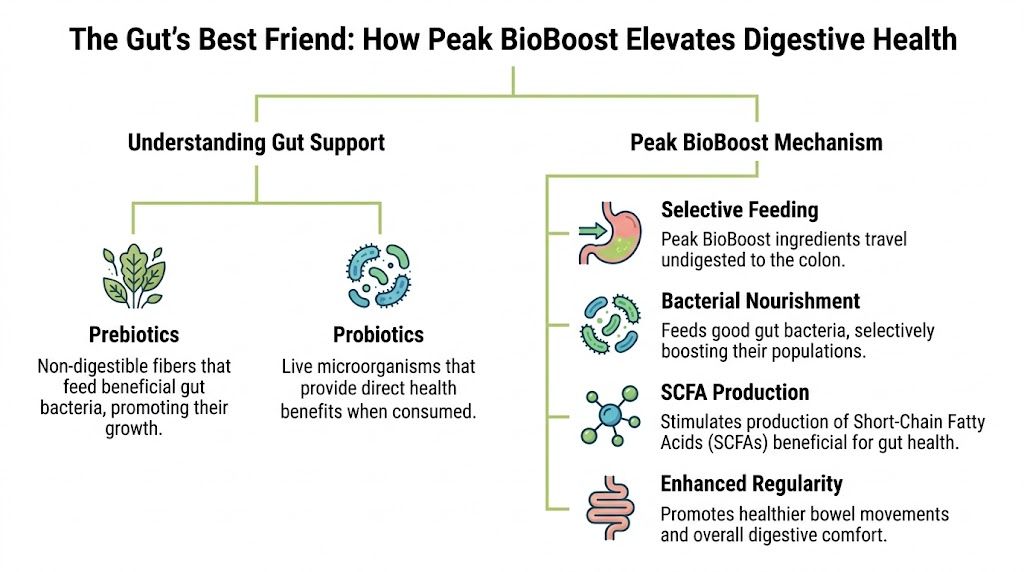
Peak BioBoost is a prebiotic, not a probiotic. That distinction sounds technical, but it changes how you should think about the product. Probiotics are the microbes themselves. Prebiotics are the fibers that feed selected microbes already living in your gut.
A simple analogy helps. Probiotics are like adding seeds to a garden. Prebiotics are like fertilizing the soil so the right plants can thrive. Peak BioBoost belongs in the second category.
Prebiotic action starts before you feel anything
The central idea is that the fibers pass through the upper digestive tract without being fully digested. Once they reach the colon, gut bacteria ferment them. That fermentation process produces short-chain fatty acids, often shortened to SCFAs, including butyrate.
According to the Globenewswire product explanation, Peak BioBoost works by relaxing perirectal nerves, accelerating colonic transit, and using prebiotic fibers to produce SCFAs like butyrate, which lowers gut pH to suppress pathogenic bacteria and favor beneficial Bifidobacterium growth by 1 to 2 log CFU/g. That’s the densest scientific claim around the product, and it gives a useful framework for understanding what users may be responding to.
Four mechanisms matter more than one big promise
Peak BioBoost is easiest to understand if you break it into four digestive jobs.
Nerve support and easier passage
The first job is mechanical coordination. If the lower digestive tract is tense or poorly coordinated, stool can sit longer than it should. The product description links Peak BioBoost to relaxation of perirectal nerves and smooth muscle behavior. Think of this like unkinking a garden hose. Water may still move slowly if pressure is low, but it won’t move well at all if the hose is twisted.
Many constipated people don’t just have “not enough fiber.” They also face a rhythm problem, as the gut isn’t moving smoothly.
Faster transit through the colon
The second job is movement speed. Fiber can help pull water into the intestinal contents and support softer stools. Softer stool usually moves with less resistance than hard, dry stool.
That’s a different effect from a stimulant laxative. Instead of forcing a bowel movement, the formula is framed as making the intestinal contents easier to move through the system.
Feeding beneficial bacteria
The third job is microbiome shaping. Prebiotic fibers become fuel for bacteria that produce SCFAs. Those compounds change the local gut environment. Lower pH can make it harder for less desirable microbes to dominate, while beneficial organisms such as Bifidobacterium may gain an advantage.
The most credible version of the Peak BioBoost story isn’t “it flushes you out.” It’s “it changes the conditions that make regularity easier.”
That’s an important difference because it sets expectations. A microbiome-directed supplement usually works best when taken consistently rather than sporadically.
Stool quality and comfort
The fourth job is practical rather than molecular. If the stool is bulked appropriately and softened enough, bowel movements often feel less incomplete. For many people, that’s the ultimate endpoint that matters. Not abstract gut health, but whether the daily bathroom experience feels normal again.
What this means for a buyer
A product with this mechanism is best suited to people who need support with regularity, stool consistency, and a calmer fermentation pattern. It’s less suited to someone who wants a rescue product for severe acute constipation today.
That’s why peak bioboost reviews can sound mixed even when the underlying mechanism is reasonable. Buyers may be using the product for different problems. A prebiotic can be sensible science and still be the wrong tool for the wrong expectation.
A Deep Dive into Peak BioBoost Ingredients
Ingredient analysis is where many gut supplements start to separate into two groups. Some rely on broad “proprietary blend” language with little practical meaning. Others show a clearer digestive logic. Peak BioBoost falls closer to the second camp, though there’s still a limit to how precise any outsider can be without full formula transparency.
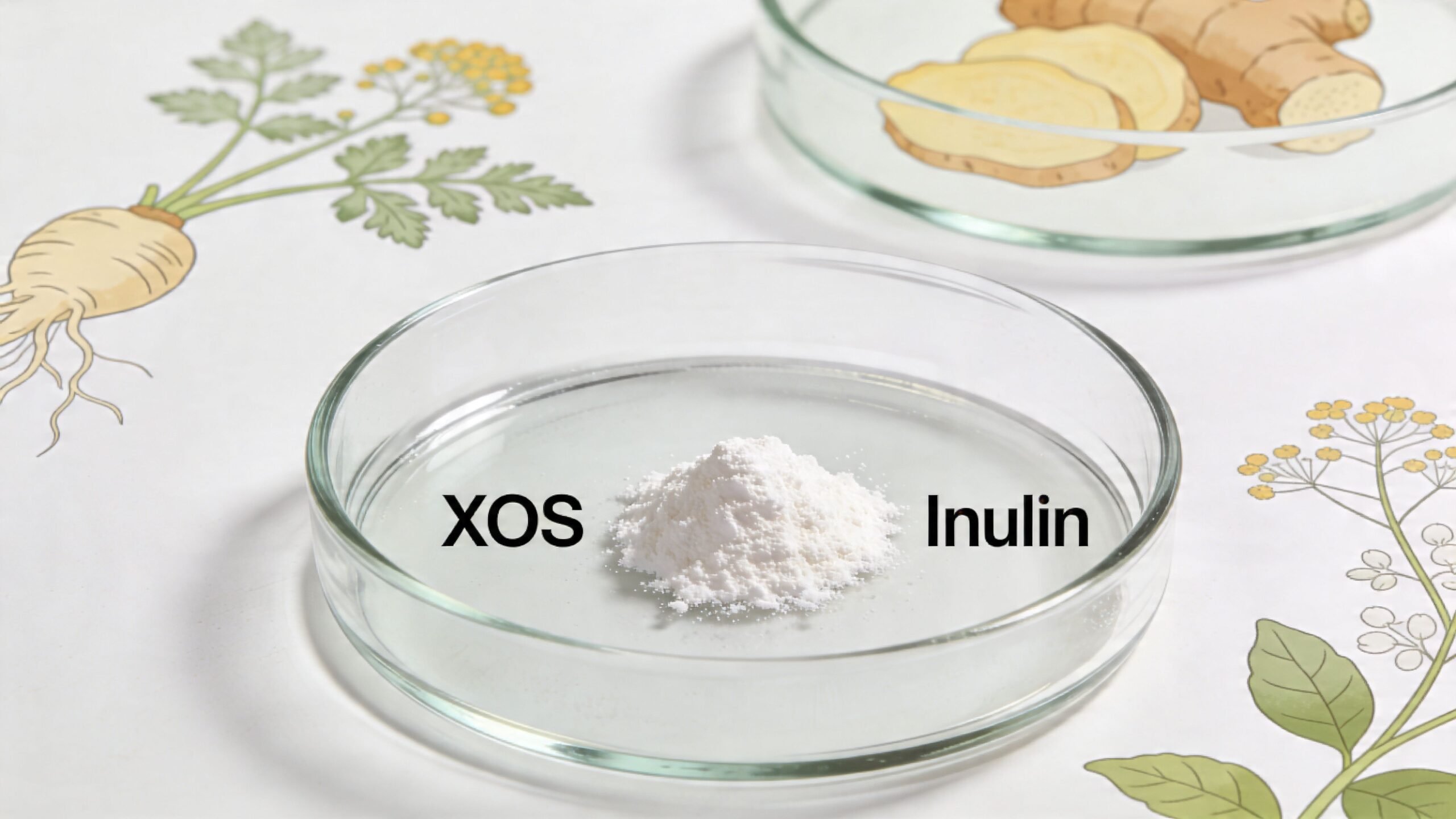
The ingredients commonly associated with the formula in reviews and product discussions include xylooligosaccharides (XOS), inulin, fructooligosaccharides (FOS), acacia gum, and magnesium citrate. Together, that suggests a product built around fermentable fibers plus a mineral ingredient that may support bowel movement ease.
XOS and the case for selective feeding
XOS is one of the more interesting fibers in the Peak BioBoost conversation because it fits the product’s “feed the right bacteria” positioning. In user benchmarks cited by Access Newswire’s 2025 review summary, 70 to 80% of buyers reported smoother digestion within one week, and that report attributes part of the effect to ingredients like XOS that soften hard stools, with anecdotal logs noting a 40% reduction in straining scores.
Those numbers should be read as user-reported benchmarks, not hard clinical proof. Still, they align with why XOS often interests gut-health formulators. It’s used to support beneficial bacterial activity without always provoking the same reputation for gas that more aggressive fermentable fibers can create in sensitive users.
Inulin and FOS offer the classic prebiotic push
Inulin and FOS are well-known prebiotic fibers. Their appeal is straightforward. They aren’t there to provide calories or immediate symptom suppression. They’re there because gut bacteria can ferment them into compounds that support the colonic environment.
That’s the scientific logic behind the product’s microbiome claims. In practical terms, these ingredients aim to make the colon a better place for helpful bacteria and a less welcoming place for organisms associated with an unhealthy microbial balance.
A discerning buyer should also understand the tradeoff. Fibers that ferment can help regularity, but fermentation is exactly why some users notice an adjustment period. If your gut is highly reactive, even a smart formula can feel bumpy at first.
Acacia gum and magnesium citrate add a practical layer
Acacia gum is often valued because it’s generally seen as a gentler soluble fiber. In a blend like this, it likely serves a balancing role by supporting stool consistency without making the formula feel like a harsh bowel product.
Magnesium citrate has a different reputation. People usually associate it with bowel movement support because magnesium can draw water into the intestines. In a formula that already includes prebiotic fibers, it can contribute to the “soften and move” side of the equation rather than only the “feed bacteria” side.
A blend like this is trying to do two jobs at once. It wants to improve the gut environment over time and make bowel movements easier in the near term.
Why the formula design matters more than any single ingredient
If you isolate any one ingredient, you can overstate or understate the product. Peak BioBoost doesn’t hinge on one superstar compound. Its logic comes from combining fermentable fibers with supportive agents that may improve stool texture and transit.
That also explains why the powder format matters. Reports describe it as flavorless and easy to mix into water or food. Adherence is underrated in gut supplements. A biologically elegant formula won’t help much if people stop using it after three days because it tastes awful or feels inconvenient.
Here’s the strongest ingredient-level takeaway:
- For regularity seekers: the blend makes sense because it combines microbiome feeding with stool-softening support.
- For highly sensitive guts: the same fermentable quality that makes prebiotics useful can also create an adjustment phase.
- For buyers expecting medication-like effects: the ingredient profile suggests gradual support, not a dramatic pharmacologic intervention.
Evidence for Bloating Constipation and IBS
You wake up feeling swollen, skip breakfast because your abdomen already feels full, and realize you still have not had a satisfying bowel movement in two days. That is the setting in which many people try Peak BioBoost. The practical question is narrower than the marketing language. Will it help constipation, will it ease bloating, and does that add up to meaningful IBS relief.
Those outcomes overlap, but they are not interchangeable. Reviews make more sense once you separate them.

Constipation has the clearest rationale
Among the three symptom groups, constipation is where Peak BioBoost has the best fit between mechanism and user experience. A prebiotic-fiber formula can increase stool bulk, improve water retention in the stool, and support colonic fermentation that may help transit in some users. That does not guarantee relief, but it gives the product a biologically plausible role in mild to moderate irregularity.
User feedback across retail and review content tends to cluster around this same point. The strongest positive comments are usually not about dramatic gut healing. They are about more predictable bowel movements, less straining, and a better sense of complete evacuation.
That pattern matters.
It suggests the formula is most useful when the main problem is sluggish bowel function, not diffuse digestive distress with many possible causes. If constipation is being driven by opioid use, pelvic floor dysfunction, severe hypothyroidism, or an undiagnosed gastrointestinal disorder, a prebiotic powder is less likely to change the picture in a major way.
Bloating sits in a gray zone
Bloating reviews are mixed for reasons that are easy to explain physiologically. Some people feel less abdominal pressure once stool is moving more regularly. In that case, the product did not directly "treat bloating." It reduced one cause of bloating, which was backed-up stool and slower transit.
Others report the opposite early on. Fermentable fibers can increase gas production while the microbiome adjusts, especially in people who have been eating a low-fiber diet. That short-term increase in fullness does not mean the product is failing, but it does mean marketing claims about universal bloating relief deserve skepticism.
For a quick visual comparison of how different gut-support categories are positioned, the digestive supplement comparison image is a useful reminder that prebiotics, probiotics, and bowel-motility aids solve different problems.
IBS requires the most careful interpretation
IBS is a syndrome, not a single mechanism. A person with IBS-C, defined mainly by constipation and hard stools, is very different from someone whose main issues are diarrhea, pain after meals, or marked sensitivity to fermentable carbohydrates. Peak BioBoost makes the most sense for the first group.
Clinical evidence on prebiotic fibers in IBS is mixed because dose, fiber type, and patient subtype all matter. Some fibers can improve stool frequency in constipation-predominant patients. The same fermentable quality can worsen gas and discomfort in people with a more sensitive gut. That helps explain the split in customer reviews. Supportive for some. Irritating for others.
So the practical verdict is narrower than many buyers expect. Peak BioBoost may be a reasonable option for IBS-C users who tolerate fiber fairly well and want a gentler daily support tool. It is a weaker fit for IBS-D, for people with severe food-triggered bloating, and for anyone hoping one supplement will control the full IBS symptom cluster.
| Symptom goal | How Peak BioBoost likely fits |
|---|---|
| More regular bowel movements | Strongest match |
| Softer stools with less straining | Good match |
| Less general digestive heaviness | Possible, if irregularity is a major driver |
| Broad IBS symptom control | Mixed and highly individual |
| Immediate rescue relief | Weak match |
A short product video may help some readers see how the supplement is positioned in practice:
The synthesized verdict from reviews and mechanism
The most useful conclusion is not that Peak BioBoost is good or bad. It is that the positive and negative reviews often describe different use cases. People who want steadier bowel habits tend to report the most satisfaction. People who buy it for broad abdominal symptom relief often sound less convinced.
That gap between ingredient logic and review variability is a key takeaway. The formula appears best suited to constipation-forward users, including some with IBS-C traits, while bloating-dominant and highly sensitive users should expect a less predictable result.
Good digestive supplements often disappoint for the same reason they succeed. They work for the problem they target, not for every problem buyers wish they targeted.
Safe Dosing Timing and Potential Side Effects
You take the first full scoop at night because the label sounds straightforward. By the next morning, you are not asking whether the product is “working.” You are asking whether the extra gas, pressure, or sudden urgency means you took too much, took it at the wrong time, or picked the wrong type of supplement for your gut.
That scenario is common with prebiotic powders because response depends as much on dose tolerance as on formula quality. Peak BioBoost is better approached like a fermentable fiber intervention than a general wellness drink. The practical question is not only whether it can improve bowel regularity, but whether your gut can adapt to it without creating enough discomfort to make daily use unrealistic.
Start with tolerance, then build toward the label dose
The product guidance recommends one to two scoops daily, but the smarter starting point for many adults is below that range. This matters most for people with a history of bloating, fiber sensitivity, IBS-like reactivity, or inconsistent intake of vegetables and other fermentable carbohydrates. A gut that is not used to added prebiotic substrate often reacts first, then settles later.
A measured ramp-up usually works better than enthusiasm:
- Start with a partial serving if you tend to react strongly to fiber supplements
- Hold that dose for several days before increasing
- Use it daily, since sporadic dosing makes it harder to judge whether symptoms reflect adaptation or random variability
- Increase only if stools improve without meaningful discomfort
This approach lines up with how clinicians often introduce other fermentable fibers. The goal is to find the lowest effective dose, not to reach the maximum dose as fast as possible.
Timing is a routine question more than a pharmacology question
Peak BioBoost does not require a highly precise dosing window. It works through fermentation and stool-softening effects over time, so consistency usually matters more than clock time. Evening use may suit people who want to observe whether they have an easier bowel movement the next morning. Morning use may be better for people who prefer taking supplements with breakfast and can stick to that pattern.
The useful rule is simple. Pick the time you can repeat.
If you are comparing gut supplement schedules more broadly, this visual guide on best timing for probiotic use offers a helpful reference point, even though Peak BioBoost is a prebiotic rather than a probiotic. That distinction matters because probiotics add microbes, while prebiotics feed microbial fermentation that can also produce gas.
The side effects fit the mechanism
The expected side effects are not mysterious. They are the predictable result of introducing fermentable fiber into the gut.
Common early complaints include:
- Gas
- Abdominal fullness
- Mild cramping or pressure
- More noticeable bowel activity during the adjustment period
Those effects do not automatically mean the product is unsafe or ineffective. They often mean the dose exceeded current tolerance. That also helps explain the split in customer feedback. Users focused on constipation relief may accept a few days of extra gas as a fair trade. Users who bought it mainly for bloating may judge the same response much more harshly.
That gap between mechanism and review experience is important. A prebiotic can be doing what it is designed to do and still feel like a poor fit for a sensitive user.
Practical rule: assess tolerance over several days at a modest dose, not after one aggressive serving.
Who should be more careful
Pregnant or breastfeeding women should not self-start this product without clinician input. The same caution applies to anyone taking medications, managing a diagnosed gastrointestinal disorder, or dealing with severe abdominal pain, rectal bleeding, unexplained weight loss, or major changes in bowel habits.
For those groups, the issue is not that prebiotic fiber is dangerous. It is that symptom interpretation becomes harder when an existing condition, medication effect, or pregnancy-related bowel change is already in the picture. In real-world use, that is where “natural” stops being a helpful shortcut and individualized medical judgment becomes more important than supplement marketing.
Pros Cons and Is It Worth the Price
A common buyer scenario looks like this. You are not searching for a dramatic cleanse or same-day laxative effect. You want steadier bowel movements, less straining, and a product you can keep using without turning your morning into a routine built around urgency. In that narrower role, Peak BioBoost makes more sense than its marketing sometimes suggests.
Price matters because this is a daily-use product, not a one-off fix. As noted earlier, the multi-container option brings the per-container cost down, and the company pairs that with a one-year money-back guarantee and a long shelf life. Those details do not prove effectiveness, but they do lower the financial risk for someone who needs a few weeks to judge whether the formula improves stool consistency and regularity.
Peak BioBoost at a glance
| Pros | Cons |
|---|---|
| Prebiotic-first formula matches its main use case of supporting regularity | Benefit is less predictable for users whose main complaint is bloating rather than constipation |
| Flavorless powder is easier to use consistently than large capsules for some buyers | Early gas, fullness, or cramping can make adherence harder |
| Compatible with several dietary patterns, including vegan and paleo eating styles | Premium pricing looks harder to justify if a simpler soluble fiber would meet the same goal |
| Refund policy reduces trial risk | Limited retail presence makes side-by-side comparison shopping less convenient |
| Better aligned with non-stimulant daily bowel support than quick relief products | Not a substitute for a clearly labeled probiotic if strain selection is your priority |
The main strength of Peak BioBoost is fit, not universality.
For the right user, the price can be reasonable. That user usually has mild to moderate constipation tendencies, wants non-stimulant support, and is willing to build up slowly enough to tolerate fermentation. In that context, the formula design and easy mixing format have practical value beyond ingredient theory.
The value case weakens in three situations:
- You want fast relief rather than gradual bowel regularity
- You react poorly to fermentable fibers and already know gas is a major trigger
- You are shopping for a probiotic-centered product and prefer to compare options using a visual roundup of probiotic formats and features
Customer feedback fits that pattern. Positive reviews often come from users who wanted help with stool frequency or ease of passage and gave the product time to work. Negative reviews more often reflect a mismatch between expectation and mechanism. Some wanted bloating relief first. Others wanted a gentler response than a fermentable prebiotic can realistically deliver during the adjustment phase.
My verdict is selective. Peak BioBoost is worth the price for buyers who want consistent, non-stimulant regularity support and understand that a prebiotic can improve bowel habits while still causing temporary digestive friction. It is less compelling for casual supplement buyers, highly sensitive users, or anyone who could get similar results from a simpler, lower-cost fiber routine.
Vetted Peak BioBoost Alternatives for Different Needs
No single supplement deserves to be the default answer for every digestive complaint. Peak BioBoost is a prebiotic-first regularity product. If that’s not exactly what you need, another category may serve you better.
If you want probiotics rather than prebiotics
Some buyers don’t primarily want fiber support. They want live organisms in a clearly defined probiotic format. In that case, a dedicated probiotic product may be more aligned with your goal than Peak BioBoost.
This is especially true if you already get plenty of fiber from food and you’re more interested in strain-based supplementation. A useful visual starting point is this roundup image on best probiotics for women, even for readers outside that audience, because it highlights how probiotics are often evaluated differently from prebiotic powders.
If your main need is basic daily fiber
Some people don’t need a specialized blend. They need a simpler, lower-cost fiber habit they’ll stick with. For that person, a plain soluble fiber product may be more practical than Peak BioBoost.
That doesn’t make Peak BioBoost a poor product. It means the premium may only be justified if you value the combined prebiotic design and the product-specific regularity positioning.
If you’re highly sensitive to fermentation
This is the group most likely to struggle with any prebiotic formula. If fermentable fibers regularly trigger gas or discomfort for you, it may be better to start with very gentle fiber changes or clinician-guided IBS strategies before trying a blend like Peak BioBoost.
A good decision filter is this:
- Choose Peak BioBoost if your core problem is constipation and you want a gradual, microbiome-aware product.
- Choose a probiotic-focused option if you care more about strains than fiber.
- Choose a simpler fiber product if budget and routine are your top priorities.
- Choose medical guidance first if your symptoms are severe, new, or highly reactive.
The bigger decision framework
The hidden mistake in supplement shopping is choosing by popularity instead of problem type. Peak BioBoost’s best use case is narrow enough to be believable. That’s a compliment. Products that claim to fix everything usually communicate less science, not more.
If you know your main issue is poor regularity, this product remains a credible option. If your issue is broader, your best alternative may not be a competing prebiotic at all.
Frequently Asked Questions
How long does one container last
That depends on whether you use one scoop or two scoops daily. The product guidance recommends one to two scoops per day, so duration will vary with your chosen routine.
Can you take Peak BioBoost with a probiotic
In many cases, people pair prebiotics with probiotics because they do different jobs. Peak BioBoost is designed to feed beneficial bacteria rather than supply them directly. If you already use a probiotic, combining them may make conceptual sense, but anyone with a sensitive gut should introduce only one change at a time so it’s easier to judge tolerance.
Is Peak BioBoost safe for long-term use
The product is positioned for ongoing use rather than short bursts, and the long shelf life supports that. Still, “safe long term” depends on your health status, medications, and why you’re taking it. If your constipation is chronic or worsening, don’t let a supplement delay proper medical evaluation.
What does doctor-formulated actually mean
It usually means a physician was involved in designing or endorsing the formula. It does not automatically mean the product itself has been tested like a prescription drug. For buyers, the more important question is whether the formula has a plausible mechanism and whether real-world use aligns with that mechanism.
Who is Peak BioBoost actually for
My answer is specific. It’s best for adults seeking non-stimulant support for regular bowel movements who can tolerate fermentable fibers and want a mixable daily powder. It’s a weaker match for people seeking urgent relief, people with very broad IBS complaints, and anyone who is pregnant or breastfeeding.
If you want more evidence-based digestive supplement reviews, practical gut health guides, and side-by-side comparisons written for careful buyers, visit Healthy Gut Review.