

You’re standing in the pharmacy aisle, staring at orange tubs, clear capsules, gummies, powders, and labels that all seem to promise the same thing. “Supports regularity.” “Gentle relief.” “Daily fiber.” If you’ve been constipated for days or weeks, that wall of options can feel less helpful than confusing.
Many individuals don’t need more marketing. They need a clear answer to a simple question. Which fiber supplement is most likely to help my kind of constipation, without making me feel worse?
That’s where many articles fall short. They lump all fiber together as if one scoop is the same as another. It isn’t. Some fibers pull water into stool and soften it. Some mainly add bulk. Some are more likely to cause gas. Some have the best evidence for chronic constipation. Some are better thought of as “general fiber support” than true constipation relief.
If you’ve already tried drinking more water, eating prunes, or grabbing the first supplement you recognized, and you still feel backed up, bloated, or uncomfortable, you’re not alone. Constipation is frustrating partly because the problem isn’t always just “not enough fiber.” Sometimes it’s the wrong kind of fiber. Sometimes it’s too much too fast. Sometimes fiber isn’t the right tool at all.
This guide takes the patient-education approach. You’ll learn which supplements deserve a place on a short list, how each one works, how to choose based on your symptoms, and when to pause and talk with a clinician instead of pushing through.
The Frustrating Search for Constipation Relief
Constipation has a way of taking over your whole day. You wake up feeling full. Your stomach feels tight by afternoon. You sit on the toilet longer than you want to admit, then head to work or school still uncomfortable. By evening, you’re searching online for “best fiber supplements for constipation” and finding lists that read more like product ads than useful guidance.
A lot of readers are in one of three situations. They’re dealing with occasional constipation and want something safe to keep on hand. They’ve had a chronic pattern of hard, infrequent stools and want something they can use consistently. Or they’ve already tried a fiber product and felt more bloated, more gassy, or somehow even more stuck.
That last group gets discouraged fast. It’s easy to assume fiber “doesn’t work for me.” In reality, the issue is often more specific than that.
Why the supplement aisle feels so confusing
Labels rarely explain the part that matters most. They don’t tell you, in plain language, whether a product is better at softening stool, adding bulk, or feeding gut bacteria. Those are not the same job.
A powder made with psyllium behaves differently from a capsule made with calcium polycarbophil. A supplement that’s marketed as a daily wellness fiber may not be the best choice if your real problem is dry, hard stool that’s difficult to pass.
“Not all fiber is created equal” sounds like a cliché, but in constipation care it’s the whole story.
What actually helps people choose well
A good choice starts with a few practical questions:
- What does your constipation feel like? Hard, dry stool often points toward a gel-forming option.
- Do you bloat easily? Some fibers are easier to tolerate than others.
- Do you want a powder or pills? The best supplement is one you’ll use correctly.
- Are you taking medicines every day? Timing matters, because fiber can interfere with medication absorption.
You don’t need an advanced nutrition degree to sort this out. You need a framework. Once you understand what each type of fiber does inside the gut, the product list gets much shorter and much less overwhelming.
How Different Fibers Work to Relieve Constipation
A lot of people stand in the supplement aisle staring at labels that say soluble, insoluble, natural, daily, or gut health, and none of that answers the question: will this help me pass stool more easily?
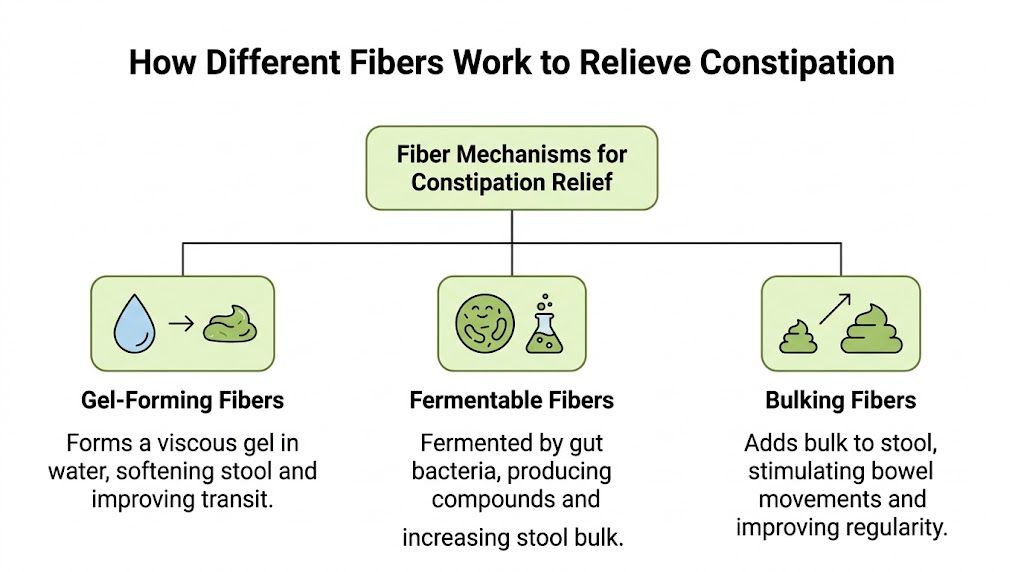
For constipation, the more useful question is what the fiber does once it reaches your gut. Some fibers hold water and soften stool. Some mainly add mass. Some are quickly fermented by gut bacteria, which can help in some situations but can also bring more gas.
Gel-forming fibers hold water where you need it
Gel-forming fiber works like a sponge in the bowel. After you drink it with enough fluid, it absorbs water and forms a soft gel. That gel helps stool stay moist, larger, and easier for the colon to move along.
Many cases of constipation involve stool that is too dry and hard. Adding dry bulk alone does not solve that problem very well. A fiber that holds water often makes more sense.
Psyllium is the best-known example. It has two helpful effects at the same time. It keeps water in the stool, and it gives the colon enough stretch to encourage a bowel movement. A clinical review of psyllium and chronic constipation describes these gel-forming and mechanically stimulatory effects, and it also summarizes why psyllium has stood out in clinical guidance (clinical review of psyllium and chronic constipation).
If you have ever added bran to your diet and felt more stuffed than relieved, this is often why. Your gut may have needed hydration and softening, not just more material.
Fermentable fibers feed gut bacteria first
Some fibers are used up quickly by gut microbes. In other words, bacteria get to them before they can do much bulking or gel-forming work in the stool.
That can be useful for general gut health. It may also produce gas, bloating, or pressure, especially in people who already feel distended. Fermentation is not harmful by itself, but it is not always the best first match for stubborn constipation.
Inulin is a good example. It is often marketed for digestive wellness, yet some people with constipation find that it causes more bloating than relief. A review in Nutrients explains that different fibers vary in viscosity, fermentability, and stool effects, which is why two products labeled "fiber" can feel completely different in the body (review of functional fiber characteristics and clinical effects).
Bulking fibers add mass, but they need fluid
Bulking fibers increase stool weight or volume. That extra mass can help trigger the colon to contract.
Calcium polycarbophil is one example. Wheat bran is another, though it is used more often as a food than as a supplement. These options can help some people with mild constipation or irregularity.
The catch is hydration. If you add bulk into a slow, under-hydrated system, stool can feel heavier without becoming easier to pass. That is one reason people sometimes say fiber made them feel worse.
A simple comparison helps:
| Fiber category | Main job in the gut | Best fit | Common drawback |
|---|---|---|---|
| Gel-forming | Holds water and softens stool | Hard, dry stool and straining | Can thicken quickly if not mixed well or taken with enough water |
| Fermentable | Feeds gut bacteria | People focused on microbiome support, sometimes mild irregularity | More gas or bloating in sensitive people |
| Bulking | Adds stool mass to stimulate movement | Mild constipation, people who prefer tablets or simple maintenance products | Can feel heavy or uncomfortable if fluid intake is low |
Why psyllium often comes up first
Among fiber supplements, psyllium usually has the strongest clinical support for constipation. That does not mean it is right for every person. It means it is often the most reasonable starting point when the main complaint is hard stool, straining, or infrequent bowel movements.
The reason is practical, not just academic. Psyllium addresses two common problems at once. It softens stool by holding water, and it helps the bowel move that stool forward.
That is different from a supplement chosen mainly for gut bacteria or a product that adds dry bulk without much gel formation.
Helpful shortcut: If your stool is dry, pebbly, or painful to pass, a water-holding fiber usually makes more sense than a heavily fermentable one.
A few terms that confuse people
People often assume soluble fiber automatically means good for constipation. That is too broad. Some soluble fibers form a helpful gel. Others are rapidly fermented and may cause more bloating than stool relief.
People also hear insoluble fiber and assume it will sweep the gut clean. Sometimes it helps. Sometimes it just adds roughage to stool that is already dry.
The better question is not "Is it soluble?" The better question is "Does it soften, bulk, or ferment first?"
That one shift in thinking makes product labels much easier to read.
How to Choose the Right Fiber Supplement for You
A good fiber supplement should match your symptoms, your tolerance, and your routine. If you pick based only on brand recognition, you might end up with a product that’s hard to take consistently or one that makes your bloating worse.

Start with the stool, not the label
If your stool is small, hard, dry, or painful to pass, a gel-forming option is usually the most logical place to start. That points many people toward psyllium.
If your bowel pattern is only mildly irregular and you mainly want a simple maintenance product, a bulk-forming option may be enough. If you know you react badly to fermentable ingredients and tend to get gassy fast, you may do better with a less fermentable choice.
A few symptom-based matches can help:
Hard stool with straining
Psyllium often makes the most sense because of its water-holding gel action.Constipation plus frequent bloating sensitivity
A gentler, less fermentable option may feel easier to tolerate, though the evidence base for constipation relief is not as strong as it is for psyllium.Preference for pills over powder
Calcium polycarbophil products such as FiberCon can be more appealing if you dislike thick drinks.
Think about what you can realistically stick with
Powders work well for many people, but not everyone wants to stir a drink every day. Capsules are more convenient, but you may need multiple pills depending on the product. Gummies can be appealing, but they aren’t always the best fit for constipation-focused therapy.
The practical questions matter:
| Question | Why it matters |
|---|---|
| Do you hate thick textures? | Psyllium powders gel quickly and some people dislike that. |
| Do you travel often? | Capsules or packets may be easier to use consistently. |
| Are you already struggling to drink water? | Some fibers are a poor choice if hydration is inconsistent. |
Don’t ignore your health history
At this point, supplement shopping should slow down. If you have IBS, IBD, a history of bowel narrowing, or trouble swallowing, your “best” supplement may not be the one with the strongest general reputation.
Some people with IBS-C do well with psyllium. Others feel worse with certain fibers, especially if gas and fermentation are already a big part of the picture. If you have digestive pain, a lot of distention, or constipation that doesn’t respond to typical measures, it’s worth stepping back before trying larger and larger doses.
The best supplement is the one that fits your bowel pattern, your tolerance, and your safety profile. Those three matter more than marketing claims.
A simple picking framework
If you want a quick way to narrow the field, use this checklist:
Choose by function
Need stool softening and easier passage? Favor gel-forming psyllium.Choose by tolerance
Very sensitive to gas? Be cautious with more fermentable products.Choose by format
If you won’t drink it, don’t buy a powder tub the size of a paint can.Choose by context
Daily medications, IBS, pregnancy, or chronic symptoms all deserve extra care.
A lot of constipation care gets better once people stop asking, “Which supplement is most popular?” and start asking, “Which mechanism matches what my gut is doing right now?”
Safely Starting and Using a Fiber Supplement
Starting a fiber supplement the right way matters almost as much as choosing the right one. Many people give up too soon because they take a full dose on day one, don’t drink enough fluid, then feel bloated and conclude the product failed.
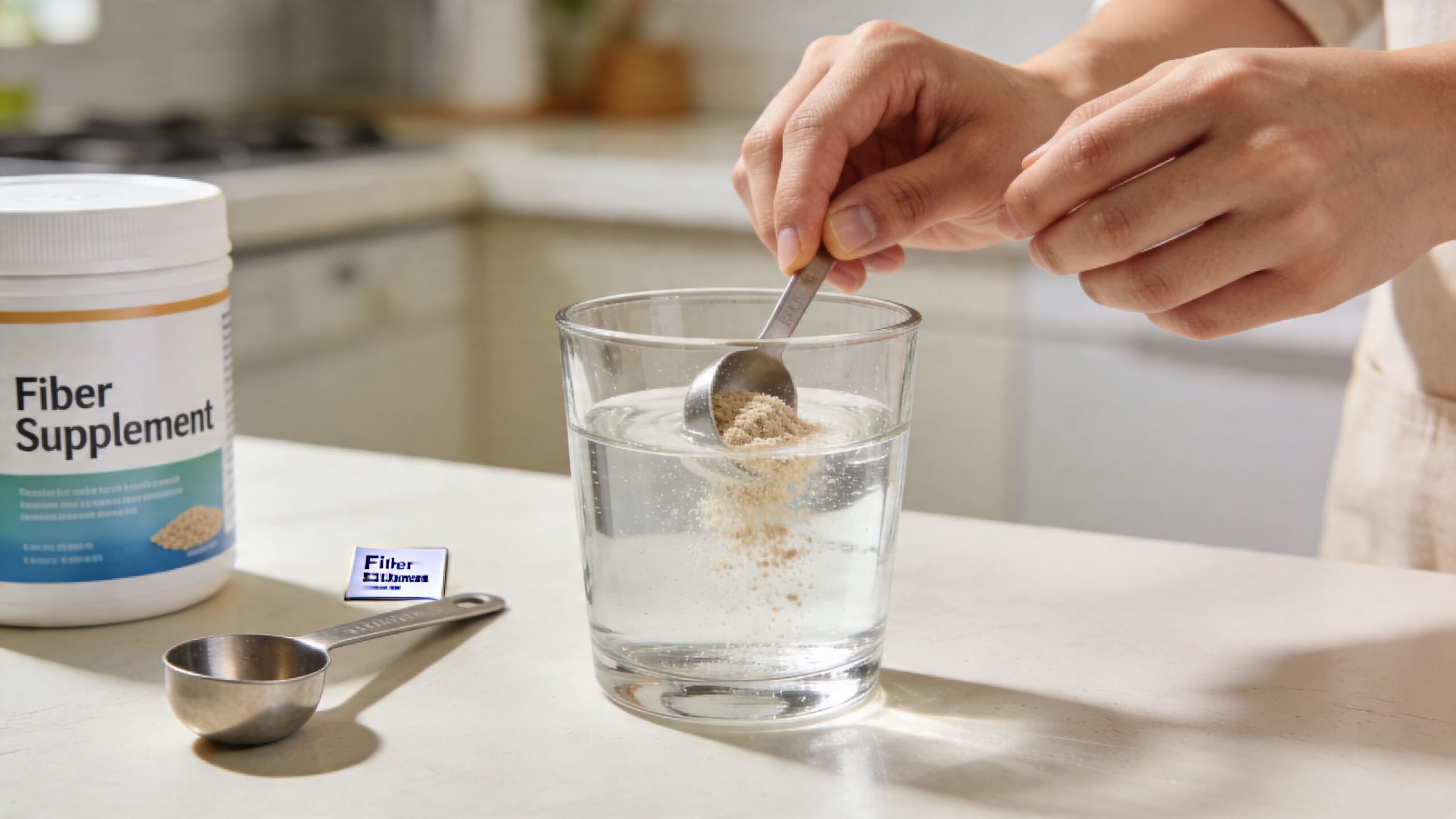
Most fiber supplements, including psyllium and calcium polycarbophil, usually produce a bowel movement within 12 to 72 hours when used correctly, and common options such as psyllium, methylcellulose, and polycarbophil are generally considered safe for daily use when appropriate (fiber supplement timing and safety overview).
Start low and go slow
Your gut needs time to adjust. That’s especially true if your current fiber intake is low.
A gentle starting plan often works better than jumping in at the full label serving:
Begin with a small amount
For psyllium, many clinicians start low rather than at a full target dose.Stay there for several days
Watch for bloating, cramping, stool changes, and how easy it feels to continue.Increase gradually
If you’re tolerating it well, step up slowly instead of doubling overnight.
This slow build reduces the chance that you’ll feel suddenly overstuffed or gassy.
Water is not optional
Fiber without enough fluid can make constipation worse. That’s one of the most common mistakes I see.
Think of fiber as a sponge. A sponge helps when it has water to hold. A dry sponge dropped into an already dry system is not useful. With gel-forming fibers in particular, fluid is part of the treatment.
If a label says to take the supplement with water, follow that instruction carefully. If you routinely drink very little during the day, fix that habit before pushing the dose upward.
If fiber makes you feel more blocked, the first question is often not “Is fiber wrong for me?” It’s “Am I taking enough fluid with it?”
Timing matters, especially with medicines
Fiber can interfere with the absorption of some medications. Store guidance aimed at consumers notes this clearly and advises checking with a pharmacist or healthcare provider before using fiber supplements alongside medicines (Walgreens fiber supplement guidance on medication absorption).
A safe rule of thumb is to separate fiber supplements from medications by at least a couple of hours unless your clinician or pharmacist gives different instructions.
This matters most for people who take several daily medicines and assume supplements are always harmless add-ons.
For a quick visual walkthrough of how to use fiber supplements well, this video can help:
What to expect in the first week
Some changes happen quickly. Others take patience.
A reasonable expectation looks like this:
| What you may notice | What it often means |
|---|---|
| Softer stool | The fiber and fluid balance is helping |
| Slight gas at first | Common during adjustment |
| No change after a few days | You may need more time, better hydration, or a better-matched product |
| Worsening fullness or pain | Stop and reassess rather than forcing a higher dose |
Consistency matters. Fiber works best when used regularly, not only on the days you feel especially backed up.
Our Top-Rated Fiber Supplements for 2026
You buy a fiber supplement, take it for three days, and feel more bloated than relieved. Then you try a different one and wonder why the results are completely different.
That confusion makes sense. “Fiber supplement” sounds like one category, but these products do different jobs in the gut. Some hold water in stool and make it easier to pass. Some mainly add bulk. Some are chosen because they are easier to tolerate, even if they are not the strongest option for stubborn constipation.
The goal here is not just to name products. It is to help you match the fiber to the problem you are having.
Quick comparison of leading options
| Product Example | Fiber Type | How it tends to work | Best For | Potential for Gas |
|---|---|---|---|---|
| Metamucil or plain psyllium husk | Psyllium | Forms a soft gel that holds water and adds bulk | Chronic constipation, hard stool, straining | Moderate |
| FiberCon | Calcium polycarbophil | Absorbs water and adds bulk | People who prefer tablets and a simple routine | Lower to moderate |
| Citrucel | Methylcellulose | Adds bulk and is usually less fermentable | People who get gassy with other fibers | Lower |
| Plain food-based seed fibers | Mixed fiber types | Depends on the blend | People who want a food-style add-on | Variable |
1. Psyllium husk products
For many adults with chronic constipation, psyllium is the first option I would discuss.
Psyllium works like a sponge in the intestines. It pulls in water, forms a gel, and helps stool become softer and fuller at the same time. That combination matters. A stool that is only bulky can still feel hard to pass. A stool that holds more water is often easier to move.
Earlier in the article, we reviewed evidence showing psyllium has the strongest support among common fiber supplements for chronic constipation, especially when used consistently and at an adequate dose over time.
Pros
- Strongest evidence among common fiber supplements
- Often helpful for hard, dry stool and straining
- Comes in powders, capsules, and flavored products
Cons
- Can cause bloating or gas, especially at first
- Some people dislike the thicker texture
- Works best when taken with enough fluid
Best for
People with ongoing constipation who want the most evidence-supported starting point.
2. FiberCon
FiberCon contains calcium polycarbophil. It is often a practical choice for someone who knows they will not stick with a powder.
Its main advantage is convenience. Tablets can feel easier to fit into a daily routine, especially for people who already take morning or evening medications and want a simple habit. In the gut, polycarbophil absorbs water and helps create a bulkier stool, which can stimulate movement. That can be useful if your pattern is infrequent bowel movements rather than very hard, dry stool.
Pros
- Tablet format is easy for many people to use
- No thick drink to mix
- Often easier to take consistently
Cons
- Clinical support is not as strong as it is for psyllium
- Still requires good fluid intake
- May be less helpful if stool dryness is the main issue
Best for
Someone who wants a pill-based fiber supplement and values convenience enough to use it regularly.
3. Citrucel
Citrucel contains methylcellulose. This is the option I think about for people who say, “Fiber helps my constipation, but the gas is miserable.”
Methylcellulose is generally less fermentable than some other fibers. In plain terms, gut bacteria tend to make less gas from it. That does not mean zero bloating for every person, but it often makes Citrucel a gentler starting point for people with sensitive digestion. The tradeoff is that it is usually chosen for tolerance first, not because it outperforms psyllium for chronic constipation.
Pros
- Often easier to tolerate if gas is a major issue
- Available as powder and caplets
- Useful as a gentler first step
Cons
- Usually not the strongest choice for persistent constipation
- May not help as much when stool is very hard
- Needs gradual dose adjustment like other fibers
Best for
People who stopped other fiber supplements because of bloating and want a milder option.
4. Plain psyllium husk powders without extra additives
Some people do best with a simple, unflavored psyllium product instead of a branded formula with sweeteners, flavors, or colors.
That approach gives you more control over the dose and the ingredient list. It can also make sense if you are trying to identify what your gut tolerates best, one variable at a time. If you are comparing fiber with other digestive health approaches, this digestive support review image for gut health supplements shows the kind of broader supplement category people often look at, but fiber should still be judged by how it changes stool form, stool water, and comfort.
A practical ranking by scenario
If you want a short shortlist, use the symptom pattern as your guide.
Best overall for chronic constipation
PsylliumBest if you hate powders
FiberConBest if gas is your main concern
CitrucelBest if you want minimal ingredients
Plain psyllium husk
A supplement can look excellent on paper and still be the wrong fit for your body. The best choice is the one that matches your symptoms, feels tolerable, and is realistic for you to use consistently.
When Fiber Might Not Be the Answer
Fiber is helpful for many people. It is not a cure-all. In some situations, adding more fiber can leave you feeling worse, not better.

That’s the part many supplement roundups skip. They treat constipation as one problem with one solution. Real patients are more complicated than that.
More fiber can sometimes worsen constipation
Clinical guidance for patients points out that increased fiber intake may sometimes worsen constipation, and the role of fiber is more complex in people with IBS or IBD (patient guidance on when more fiber may not help).
This can happen for different reasons. If the bowel is moving very slowly, adding more bulk may only increase the feeling of backup. If the problem is related to how the pelvic floor muscles coordinate during a bowel movement, extra fiber may not solve the actual issue. If you’re sensitive to fermentation, some products can increase gas, bloating, and discomfort.
A few warning patterns deserve attention:
- You feel fuller and more distended after starting fiber
- You’re straining but not passing much stool
- Gas and pressure get worse without better bowel movements
- You’ve tried fiber consistently and still feel blocked
In those situations, “just take more” is often the wrong advice.
IBS, IBD, and sensitive guts need more nuance
People with IBS don’t all respond to fiber the same way. Some with constipation-predominant symptoms tolerate psyllium well. Others react poorly to certain fermentable fibers. People with IBD may also need individualized advice depending on symptoms and disease activity.
This is one reason broad supplement marketing can be misleading. A label can’t tell you whether your bloating is from constipation alone, food intolerance, medication effects, or an underlying bowel disorder.
If you’re already managing complex digestive symptoms, it may help to track stool form, frequency, pain, and what happens after each supplement trial. Some readers compare this process with broader cleanse-style products such as those shown in this digestive cleanse review image, but if constipation is chronic or confusing, targeted clinical evaluation is often more useful than switching from one supplement category to another.
Medication timing is a real safety issue
Fiber can interfere with the absorption of medications. That means your supplement choice affects more than your bowel habits.
A careful rule is simple:
| Situation | Safer approach |
|---|---|
| You take daily prescription medicine | Ask your pharmacist how to separate timing |
| You take several morning pills | Don’t automatically take fiber at the same time |
| You’re unsure | Separate by a couple of hours and confirm with a clinician |
This matters for adults juggling thyroid medication, antibiotics, heart medications, or other chronic therapies. If you’re pregnant, breastfeeding, or giving a supplement to a child, it’s also smart to check with a clinician before starting a daily product. Fiber is common, but “common” doesn’t mean “risk-free for every person.”
Stop self-treating and get medical advice if constipation comes with severe pain, vomiting, inability to pass gas, bleeding, or a sudden major change in bowel habits.
Signs that it’s time for a medical evaluation
It’s worth asking for help if:
- Constipation keeps returning despite a thoughtful fiber trial
- You need regular rescue laxatives
- You have persistent abdominal pain or marked bloating
- Bowel movements feel blocked or incomplete every time
- Your symptoms changed suddenly
Sometimes the right next step isn’t a different fiber. It’s figuring out whether the problem is slow transit, pelvic floor dysfunction, medication side effects, or another gastrointestinal condition.
Building Lasting Digestive Regularity
A fiber supplement can be useful, but it works best as part of a bigger routine. People get the best results when they choose the right type, start with a small amount, drink enough water, and give the plan enough time to work.
For many adults, psyllium is the strongest first option when chronic constipation is the main problem. For others, convenience or tolerance matters more, and a product like FiberCon or Citrucel may be easier to use consistently. The right answer is the one that fits both your gut and your life.
Long-term regularity usually depends on a few boring habits that matter a lot:
- Eat more fiber-rich foods regularly
- Drink fluids consistently through the day
- Move your body
- Don’t ignore the urge to go
- Reassess if a supplement makes symptoms worse
That last point matters. If your body is pushing back, listen. Constipation care should make you feel more comfortable and more predictable over time, not more bloated and frustrated.
If you’re also looking at the bigger picture of microbiome support, food choices, and supplement strategy, broader gut-health resources like this Florastor review image for gut health support can be useful for context. Still, for constipation itself, matching the fiber mechanism to your symptoms remains the most practical place to start.
The goal isn’t to become dependent on a product label. It’s to understand your gut well enough that you can choose tools confidently, use them safely, and know when it’s time to get extra help.
If you want more evidence-based help comparing digestive supplements, understanding gut-friendly habits, and making sense of confusing product claims, visit Healthy Gut Review. It’s a practical resource for readers who want clearer answers on constipation, bloating, probiotics, and everyday digestive wellness.