


Most advice about kidney detox supplements starts from the wrong premise. Your kidneys aren't dirty filters waiting for a tea, capsule, or powder to “flush” them out. In a healthy body, they already do that job all day, every day.
As a clinical nutritionist, I understand why these products appeal to people. “Detox” sounds proactive, natural, and gentle. But kidney care isn't a category where good intentions are enough. This is one of those areas where marketing regularly outruns evidence.
The more useful question isn't “Which kidney detox supplement is best?” It's “How do I judge these products without getting fooled by the label?” That's the lens used here. I'll review the category critically, look at seven popular Amazon-style product types as case studies, and name the winner at the end.
The Kidney Detox Myth Debunked
The idea of a kidney cleanse sounds logical until you look at what kidneys already do.
Healthy kidneys function more like a self-cleaning water treatment plant than a sink drain that needs occasional flushing. They continuously filter blood plasma, remove metabolic waste, and send what the body doesn't need out through urine. Healthy kidneys filter approximately 180 liters of blood plasma every day, which is exactly why the claim that they need outside “detox” help falls apart on contact with physiology, as explained in this review of kidney detox myths and kidney function.

A lot of kidney detox supplements sell a feeling, not a mechanism. If a product makes you urinate more, feel lighter, or drink more water while taking it, that can create the impression that it's “working.” But more bathroom trips don't prove better kidney filtration.
Why the detox message spreads so well
The detox story succeeds because it borrows language people already use for gut reset plans, juice cleanses, and liver support. You can even see how wellness categories blur together in content around detox supplement imagery and adjacent health marketing.
That overlap is part of the problem. The kidneys aren't a stagnant holding tank. They're an active organ system with tightly controlled filtration, fluid balance, and electrolyte regulation.
The most persuasive kidney detox products usually sound the most biological. That doesn't make them biologically correct.
What actually deserves skepticism
Be cautious when a label promises any of these:
- “Flushes toxins” without naming which toxins
- “Cleanses the kidneys” without showing clinical evidence
- “Supports filtration” with no explanation of how
- “Ancient herbal detox formula” that relies more on tradition than safety data
Natural health can be valuable. But “natural” isn't a free pass, especially for kidneys. If a product affects hydration, blood pressure, potassium handling, or medication metabolism, it can matter a lot.
How Your Kidneys Actually Keep You Clean
Kidneys don't just remove waste. They manage balance.
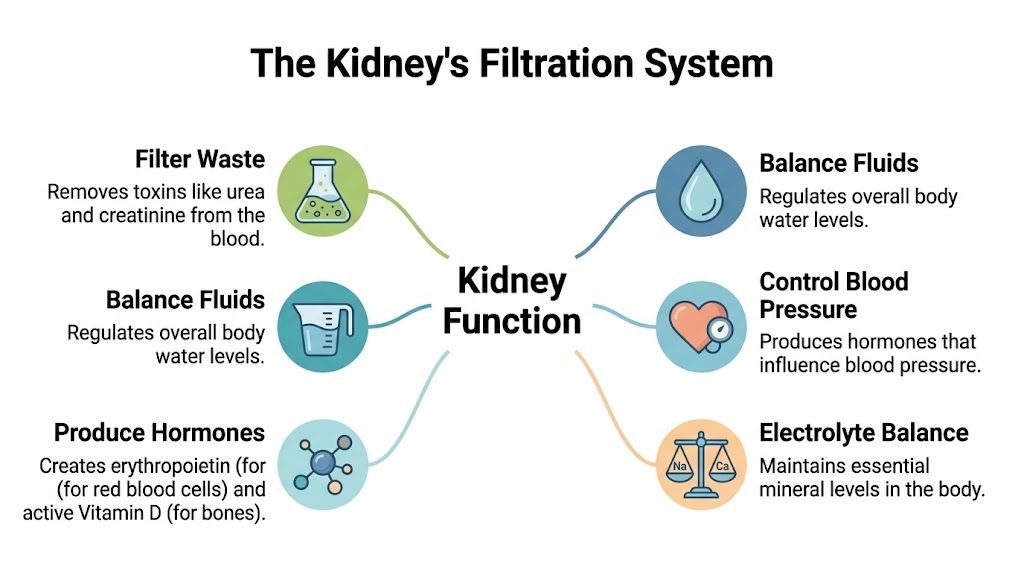
They filter blood, help regulate fluid levels, influence blood pressure, and maintain electrolyte balance. They also produce hormones involved in red blood cell production and vitamin D activation. That broad workload is why careless supplement use can create unintended problems.
The small structures doing the heavy lifting
Inside each kidney are microscopic filtration units called nephrons. Each nephron includes a glomerulus, which acts as a fine filter, and a tubular system that decides what to keep, what to recycle, and what to excrete.
That's why kidney support isn't about “scrubbing” the organ. It's about preserving the conditions those structures need to work well.
A simple way to put it:
| Kidney task | What it means in plain English |
|---|---|
| Filter waste | Removes compounds the body needs to excrete |
| Balance fluids | Prevents too much or too little water from circulating |
| Manage electrolytes | Helps control sodium, potassium, and related mineral balance |
| Influence blood pressure | Participates in systems that affect vascular tone and fluid retention |
| Support other systems | Helps with hormone-related functions tied to blood and bone health |
Hydration matters, but it isn't a cleanse
Proper hydration supports urine production and helps the kidneys do routine work efficiently. That's different from saying excess water or a “flush” protocol detoxes the kidneys.
People often confuse support with stimulation. More fluid can be helpful. Forced diuresis from herbs, teas, or restrictive cleanse plans isn't the same thing.
Why regulation matters here
The National Kidney Foundation explicitly advises people to avoid products marketed as kidney detox or kidney cleanse solutions because there's limited to no scientific evidence supporting those claims. It also notes a key regulatory issue. In the United States, herbal supplements are treated as food products rather than medicines, so they don't have to prove efficacy in the same way prescription drugs do, as outlined by the National Kidney Foundation guidance on herbal supplements and kidney disease.
If a company claims a supplement “supports filtration,” ask what human evidence shows the kidneys needed that support in the first place.
The gut and kidney connection
For readers focused on digestive health, the gut-kidney connection matters. A healthier dietary pattern can reduce inflammatory burden and may reduce the load of waste compounds the body has to handle. That doesn't make gut health a kidney detox. It means nutrition quality affects multiple systems at once.
That's why the safest “kidney support” strategies usually look boring on a label and powerful in real life. Better meals. Better hydration. Better blood pressure and blood sugar control. Less supplement roulette.
Decoding Kidney Supplement Ingredients
Kidney supplement labels usually sound more impressive than they are. Once you strip away words like cleanse, flush, and renewal, most formulas fall into a few predictable buckets.
This category sells a feeling before it sells evidence. A product can make urination more noticeable, add a familiar berry or herb, and build a story around “support” without showing that the formula improves kidney outcomes in humans. That gap matters more than the label design.
A good example of this broader wellness marketing style shows up across supplement categories, including detox product imagery built around cleansing claims. The visual language changes. The sales tactic rarely does.
The usual ingredient groups
Most kidney detox supplements rely on one or more of these ingredient types:
- Diuretic herbs such as dandelion or horsetail. These are used to increase urine output or create the sensation that the kidneys are being flushed.
- Urinary tract support ingredients such as cranberry. These are often stretched beyond their better-known use cases into broad kidney claims.
- Anti-inflammatory or antioxidant botanicals such as turmeric. These are marketed as if lowering oxidative stress automatically translates to kidney protection.
- Demulcent herbs such as marshmallow root. These are usually framed as soothing to the urinary tract.
- Proprietary blends that combine multiple herbs at undisclosed or unclear amounts, which makes any serious risk-benefit review harder.
Where the marketing gets slippery
The main problem is claim inflation.
A company may say an herb has a history of traditional use for urinary wellness. That does not mean the finished product improves kidney filtration, protects kidney tissue, or helps someone with chronic kidney disease. Those are very different claims, and supplement labels often slide between them.
In practice, I watch for three common jumps in logic:
- More urine = better detox
- Antioxidant = kidney protective
- Plant-based = safe for long-term use
None of those statements should be accepted without context. Increased urination can reflect a mild diuretic effect. It does not prove better waste clearance. An antioxidant mechanism may be interesting in a lab study and still tell you very little about whether a mixed-ingredient capsule is useful or safe in a real person.
Practical rule: if a label moves from “traditionally used” to “supports detoxification” or “supports filtration,” ask what human evidence supports the finished formula, not just the individual herb.
Why ingredient lists still leave blind spots
Even a transparent Supplement Facts panel leaves major questions unanswered.
You usually still do not know whether the exact formula has been studied, whether the dose matches any published research, or whether the product was tested in people with kidney concerns, high blood pressure, recurrent stones, or complex medication schedules. Those are the trade-offs that matter in clinic. A tidy label is helpful, but it is not a substitute for evidence.
Safety also depends on the person, not just the plant. The same ingredient that seems low risk for a healthy adult may be a poor fit for someone taking diuretics, blood pressure medication, NSAIDs, or drugs that affect fluid and electrolyte balance.
What to look for before you trust a formula
Use the ingredient list as a screening tool, not as proof that the product is sound.
Ask:
- Is each ingredient named clearly, with its dose listed?
- Does the formula rely on a proprietary blend?
- Are the claims broader than the ingredients can reasonably support?
- Would any ingredient be a concern with kidney disease, stones, blood pressure issues, or current medications?
- Is the product selling symptom sensation, like “flushing,” more than measurable benefit?
That approach will serve you better than trying to find a magic kidney herb. In this category, the smartest move is rarely finding the “best” formula. It is learning how to spot a weak one fast.
A Critical Review of 7 Popular Kidney Supplements
I can't ethically crown a “best kidney detox supplement” for a purpose that isn't supported by good clinical evidence. What I can do is review seven common product types you’ll find on Amazon and show how to judge them.
For this section, “pros” means quality markers, formula simplicity, and lower-risk design. “Cons” means weak detox logic, unclear evidence, and avoidable safety concerns. The winning product isn't hidden in this list. The winning skill is learning how to read the list.
1. Dandelion root kidney cleanse capsules
This is one of the most common formats. The pitch usually centers on flushing, water balance, and herbal cleansing.
Pros
- Simple herbal identity if the formula is mostly dandelion and not buried inside a proprietary blend
- Easy to understand use case because it mainly acts like a mild diuretic-style herb in the way it's marketed
- Often inexpensive compared with multi-herb blends
Cons
- More urination isn't proof of detox
- Can mislead people with swelling or blood pressure issues into self-treating a medical problem
- May complicate medication routines if the buyer assumes “natural” means interaction-free
Clinical verdict
This may create a sensation of flushing. That isn't the same as improving kidney function.
A capsule that increases bathroom trips can feel active. Feeling active isn't the same as being beneficial.
How I interpret user reviews
Reviews often say things like “I felt less bloated” or “I noticed a difference quickly.” That can reflect increased fluid movement, changes in hydration habits, or expectation effects. It doesn't verify kidney detoxification.
2. Cranberry plus herbal kidney support blends
These formulas often combine cranberry with parsley, dandelion, uva ursi, or marshmallow root. They usually blur urinary tract support and kidney cleansing into one message.
Pros
- Recognizable ingredients that many buyers already know
- May be less extreme in effect than stimulant-style cleanse products
- Often come with clearer labels than some obscure detox blends
Cons
- Category confusion because urinary tract support is not the same claim as kidney detox
- Multi-herb stacking can make side effects and interactions harder to predict
- Marketing inflation often stretches one familiar ingredient into a broad kidney-health promise
Clinical verdict
If someone is buying this for “kidney detox,” the claim is overbuilt. If someone is looking at urinary support, the conversation is different, but it still needs clinical context.
3. Kidney cleanse teas
Tea products are popular because they feel gentle and ritual-based. The usual formula includes diuretic herbs and “cleansing” plants.
Pros
- Encourages fluid intake
- Can replace sugary beverages
- Ritual value may help someone pay more attention to daily habits
Cons
- Detox messaging is especially misleading in tea marketing
- Harder to standardize dose across servings
- Can hide strong herbal combinations behind wellness branding
Clinical verdict
The most useful part of many kidney cleanse teas is often the water, not the herbs. If the tea gets someone to hydrate more and cut soda, that's the helpful part. The detox claim still doesn't hold.
4. Multi-herb proprietary kidney detox formulas
This is the category I trust least. The front label usually says cleanse, flush, drainage, or total renal support. The back label often says proprietary blend.
Pros
- Broad ingredient list may appeal to shoppers who want an all-in-one product
- Convenient format for people who don't want to compare separate herbs
Cons
- Hidden ingredient amounts make meaningful evaluation difficult
- Stacked herbs increase uncertainty
- Strong claims paired with weak transparency is a bad combination
Clinical verdict
If I had to eliminate one category first, it would be this one. The gap between confidence on the label and certainty in the evidence is usually widest here.
A lot of the same caution applies in adjacent supplement categories sold under broad detox language, which you can see reflected in this kind of digestive health detox marketing imagery.
5. Apple cider vinegar kidney cleanse gummies
These products sit at the intersection of wellness trend and supplement candy. They often mention cleansing, metabolism, and urinary health in the same breath.
Pros
- Easy adherence because gummies are convenient
- Transparent serving format compared with loose powders or tea scoops
- Usually mild in perceived effect
Cons
- Weak fit for kidney detox claims
- Can encourage casual overuse because gummies feel harmless
- Often built around trend appeal more than organ-specific evidence
Clinical verdict
This is mostly a branding exercise. The format may be pleasant, but the rationale for kidney detox is thin.
6. Turmeric and antioxidant renal support blends
These formulas sell the idea that antioxidant support equals kidney cleansing. That's too simplistic.
Pros
- Single-idea marketing is easier to assess when the formula centers on one main botanical
- May attract buyers away from harsher cleanse formulas
- Often paired with general wellness positioning instead of aggressive flushing language
Cons
- Antioxidant doesn't mean kidney-safe
- Can create false reassurance for people with underlying kidney concerns
- Still lacks evidence for “detox” use
Clinical verdict
A calmer label doesn't fix the core issue. A supplement can sound more impressive and still be unsupported for the job it's being sold to do.
7. Cherry extract or tart cherry kidney support products
These can sound especially appealing because the ingredient seems food-based and gentle.
Pros
- Familiar source ingredient can make buyers feel more comfortable
- Straightforward branding if sold as a single botanical product
Cons
- Food-like image can lower caution too much
- Long-term use is not automatically harmless
- Published kidney injury concerns make this a category to approach carefully
Clinical verdict
This is the clearest example of why “natural” and “benign” aren't synonyms. If a product category includes a documented signal of harm, self-prescribing it for kidney detox is hard to justify.
Which one wins
None of these products wins as a true kidney detox supplement, because the detox premise itself isn't well supported.
If someone insisted on comparing them, the least concerning options are usually the ones with:
- The fewest ingredients
- No proprietary blend
- No disease-like claims
- Clear labeling
- A reason for use that doesn't rely on detox language
That still isn't an endorsement. It's harm reduction.
The Real Kidney Detox Your Doctor Recommends
A true kidney detox isn't a product. It's a pattern.

When kidney specialists push back on cleanse marketing, they don't leave a void. They point people toward the basics that protect kidney function over time.
What works better than a cleanse
Start with the fundamentals:
- Hydration that fits your body and medical status. Enough fluid supports normal kidney work. Excessive forced hydration doesn't make the kidneys cleaner.
- A healthy eating pattern. Consistent, minimally processed meals tend to help more than short-term cleanse plans.
- Sodium awareness. Very salty diets can work against blood pressure and fluid balance.
- Avoiding tobacco products. This is a direct recommendation from medical guidance on kidney protection.
- Regular movement. Not as a detox trick, but because cardiometabolic health and kidney health are closely linked.
The gut-kidney link that actually matters
For a gut-health audience, the most practical overlap is this: a steadier digestive pattern often supports steadier overall metabolic health. Better fiber intake, fewer ultra-processed foods, and improved meal quality can reduce strain across multiple systems.
That isn't a cleanse. It's maintenance.
The body usually responds better to boring consistency than to dramatic reset plans.
A food-first approach also avoids one of the biggest problems in the kidney detox supplements market: concentrated herbal exposure without clear proof of benefit.
This short video gives a useful lifestyle-centered frame for the topic:
What I tell clients instead of buying a detox
I usually bring the conversation back to a few questions:
- Are you trying to feel less puffy, less bloated, or more energized?
- Are you worried about kidneys specifically, or using “detox” as a catch-all term?
- Have you checked blood pressure, blood sugar, medications, and daily hydration before buying herbs?
That usually reveals the issue. Often it's diet quality, a high-sodium routine, low fluid intake, a medication question, or a symptom that deserves medical review rather than a supplement cart.
How to Choose a Safer Supplement If You Must
A safer kidney supplement choice rarely starts with finding the "best" bottle. It starts with assuming the label may be overselling the benefit and underselling the risk.

That shift in mindset changes how you shop. Instead of asking, "Which detox works fastest?" ask, "What is the simplest product least likely to create a new problem?"
Start with the label, not the promise
I look for a short ingredient list, exact doses, and plain-language cautions. If a formula hides behind a proprietary blend, you cannot tell what you're getting. If the front label talks about flushing toxins, repairing kidneys, or reversing damage, I treat that as a marketing warning, not a reason to buy.
Third-party testing also matters. It does not prove a supplement will help your kidneys, but it gives you a better shot at getting what the label says, without obvious contamination or major quality-control failures.
A simple screen before you buy
Use these filters before you spend money:
- Ask a clinician first if you have kidney disease, high blood pressure, diabetes, swelling, a history of stones, or you use prescription medication regularly.
- Prefer single-ingredient or short formulas over crowded blends with ten or fifteen herbs.
- Choose products with exact amounts listed for each ingredient.
- Look for third-party certification or testing from a recognizable program.
- Read the caution panel carefully for medication warnings, pregnancy warnings, and directions not to exceed dose.
- Skip products with disease-style claims or language that sounds stronger than structure-function support.
- Stop the supplement and get medical advice if you notice nausea, unusual fatigue, reduced urination, weakness, or swelling.
Why "natural" is not a safety guarantee
One useful case study is cherry extract. It sounds mild. It is food-derived. It would not raise concern for many supplement buyers at first glance.
As noted earlier in the article, there is a published case report linking long-term cherry extract supplement use with serious kidney injury. That does not mean cherry is broadly dangerous for everyone. It does mean a familiar ingredient can still become a problem in concentrated supplemental form, especially when someone assumes "natural" means low risk.
That is the larger lesson from this product category. The hazard is not limited to exotic detox powders sold on questionable websites. Sometimes it sits in a capsule with a clean label, a fruit image, and very little context about who should avoid it.
Red flags that matter more than brand hype
I get more cautious when several of these show up together:
| Red flag | Why I take it seriously |
|---|---|
| Proprietary blend | Dose transparency is missing, so risk assessment is guesswork |
| Long ingredient list | More ingredients means more chances for side effects and interactions |
| Detox-heavy language | The sales copy is often stronger than the evidence |
| No meaningful warning section | The company may be minimizing who should avoid the product |
| Kidney disease-adjacent claims | The label may be drifting toward medical promises without clinical support |
A supplement also looks different once you place it in the context of the whole routine. If someone is eating a heavily processed diet, sleeping poorly, and running on high sodium convenience foods, the bottle is rarely the main issue. A basic reset in meal quality usually has more practical value, including cutting back on the kinds of foods shown in this visual guide to foods that can disrupt digestive health habits.
Buy the simplest product with the fewest claims. If you cannot clearly explain why each ingredient is there and what could make it unsafe for you, that is usually a good reason to leave it on the shelf.
Conclusion The Only Winner Is Your Health
If you came here wanting the best kidney detox supplements, the honest answer may feel unsatisfying at first. There isn't a winning detox product because the core claim behind the category is weak.
Kidneys aren't passive containers of sludge waiting for herbs to rinse them out. They already have a continuous filtration role. What helps them most isn't a cleanse cycle. It's protecting the conditions that let them do their job well.
So who wins this review?
Your own kidneys, when you stop asking them to carry unnecessary supplement risk.
If you're choosing between a flashy detox formula and a boring routine of hydration, better meals, blood pressure awareness, and medical guidance, take the boring routine. It has a much stronger logic behind it.
If you're still considering a supplement, don't start with the label promise. Start with your health history, your medications, and a conversation with a qualified clinician. That's the safest way to protect both your kidneys and your wallet.
Frequently Asked Questions About Kidney Cleanses
Do kidney detox supplements work
Current evidence doesn't support the broad marketing claim that commercial kidney detox supplements flush toxins or improve kidney function in the way labels suggest. Medical authorities advise avoiding products sold specifically for kidney detox or kidney cleanse purposes because the evidence behind those claims is limited.
Are kidney detox supplements safe if I have kidney disease
That's where extra caution is needed. The National Kidney Foundation notes that some supplements can accumulate, interact with medications, or directly harm the kidneys. If you have known or suspected kidney disease, don't self-prescribe a cleanse product.
Can a kidney cleanse help pass a drug test
No responsible clinician should recommend that. Kidney cleanses are marketed around vague toxin language, but that doesn't make them a reliable or safe tool for altering drug test outcomes. They can also distract from the underlying problem and may expose you to unnecessary ingredients.
Why do some people say these products helped them
Perceived benefits can come from several things. Increased water intake, temporary changes in urination, fewer sugary drinks, and expectation effects can all make someone feel better. That still doesn't prove the supplement detoxed the kidneys.
What's the safest natural way to support kidney health
The safest approach is usually not a detox supplement at all. Focus on a healthy diet, regular exercise, avoiding tobacco products, and discussing any supplement with a clinician if you have symptoms, diagnoses, or medication use.
Should I trust Amazon reviews
Use them carefully. Reviews can tell you whether a bottle arrived sealed or whether the capsules are easy to swallow. They can't confirm that a product detoxes kidneys, improves filtration, or is safe for your specific medical situation.
Healthy Gut Review publishes evidence-focused guides that help readers sort useful wellness strategies from overhyped supplement claims. If you want practical, reader-first reviews on gut health, digestive support, and smarter supplement decisions, visit Healthy Gut Review.