


Most probiotic advice starts in the wrong place. It tells you to compare labels by CFU count, then assume the product with the biggest number wins. That shortcut doesn't fit Dr. Ohhira's.
If you read enough dr ohhira probiotics reviews, a different pattern appears. People aren't just reacting to a capsule of live bacteria. They're reacting to a fermented system that combines probiotics, prebiotics, and postbiotics. That makes it harder to judge with the usual "more strains, more CFUs, better results" logic.
That difference matters because this product attracts unusually strong reactions on both ends. Some users describe dramatic digestive relief and long-term loyalty. Others raise concerns that many glowing reviews barely mention, especially around histamine intolerance, d-lactate sensitivity, carrageenan, and the complete lack of pregnancy-specific safety data. A balanced review has to hold both realities at once.
What follows is an evidence-based analysis of the formula, the strain research around it, the user reports, and the blind spots. If you're considering Dr. Ohhira's for bloating, IBS-type symptoms, travel digestion, or general microbiome support, the details matter more than the marketing.
Dr Ohhira Probiotics Reviews An Unconventional Approach
The usual probiotic scorecard does a poor job with Dr. Ohhira's. Reviews often frame it as either a premium gut supplement or a cult favorite with unusually loyal users. Neither description explains the harder question: what, exactly, are people responding to, and who may respond badly?
That is the useful starting point for dr ohhira probiotics reviews. The product sits in an awkward category between a standard probiotic and a fermented functional food. That distinction matters because user experience may reflect more than bacterial survival alone. It may also reflect fermentation byproducts, plant-derived compounds, and the way those compounds interact with a sensitive gut.
A better comparison is compost versus a packet of seeds. Seeds are easy to count. Compost is harder to reduce to one metric because its effect comes from the whole biological mix. Dr. Ohhira's attracts the same kind of confusion. Consumers searching for a simple winner by strain count or CFU count can miss what makes the product appealing to one group and irritating to another.
That split shows up in review patterns. Positive reports commonly mention less bloating, steadier bowel movements, and better stomach comfort. More cautious reports raise issues that many roundup articles skim past, especially reactions in people with histamine intolerance, people who do poorly with fermented products, and women trying to assess whether use during pregnancy is prudent despite the lack of pregnancy-specific safety research.
An honest review has to separate three questions instead of blending them together:
- What kind of product architecture is this, beyond the probiotic label?
- Which claims have at least some strain-level or mechanism-level support?
- Which groups should treat strong testimonials as interesting, not reassuring?
That last question deserves more attention than it usually gets. A supplement can have a plausible gut-health rationale and still be a poor fit for a subgroup with mast cell issues, histamine sensitivity, severe dysbiosis, or pregnancy-related caution. Reviews that ignore that tension are less useful than they look.
Beyond Bacteria The 3 Year Fermentation Process Explained
What makes Dr. Ohhira's unusual is not a headline CFU number. It is the attempt to turn fermentation itself into the product.
The company describes a long anaerobic fermentation process using mountain spring water and a mix of fruits, vegetables, mushrooms, and seaweed. That matters because extended fermentation changes the capsule from a simple delivery system for live microbes into a matured mixture of microbial byproducts, partially broken-down plant material, and surviving organisms. In practical terms, the formula is trying to deliver the results of microbial work, not only the microbes that might keep working after ingestion.
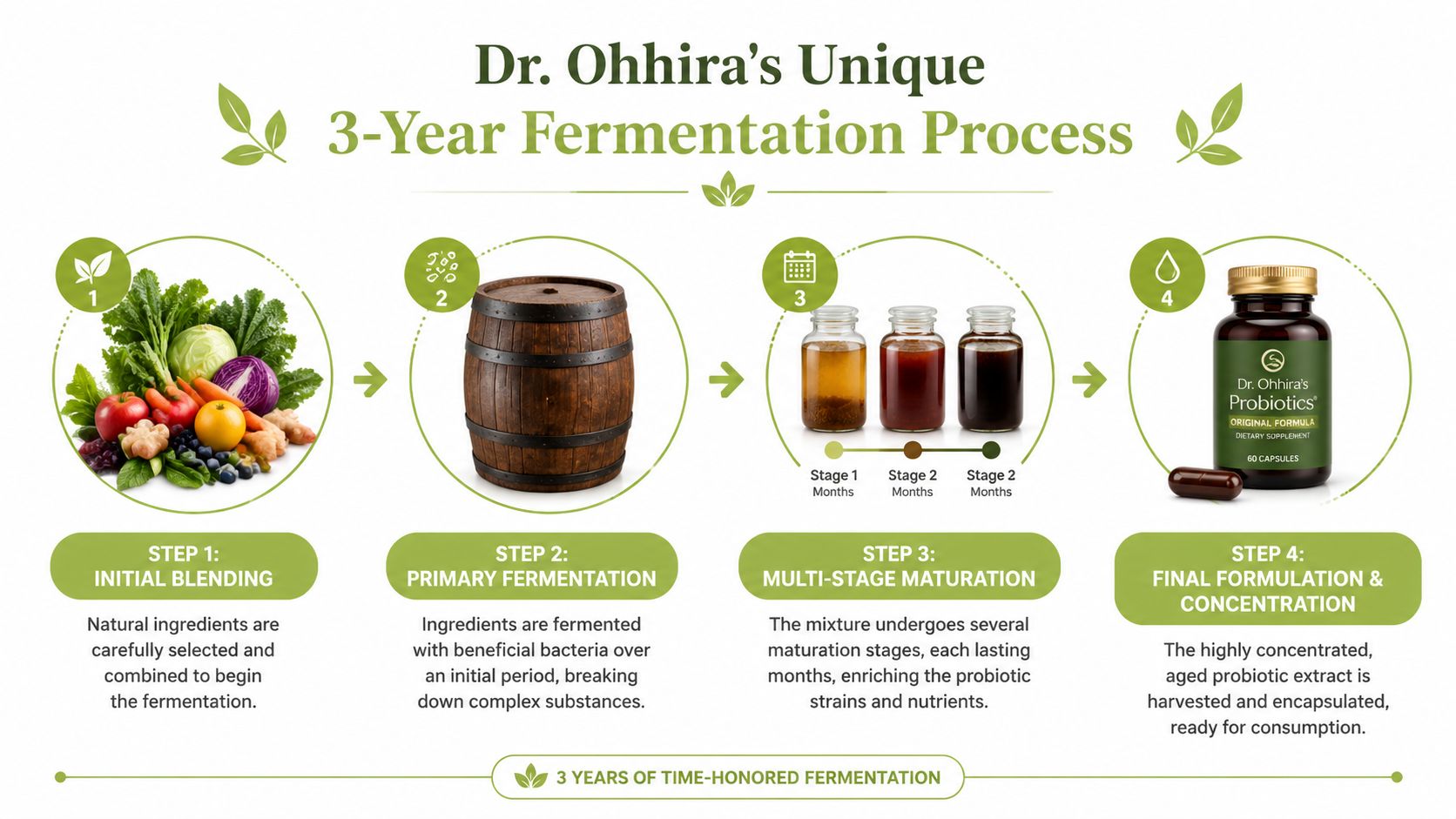
A useful comparison is a broth that has simmered for hours versus ingredients dropped into hot water at the end. The final composition is different because time changes what is extracted, transformed, and made available. Fermentation works in a similar way. Bacteria consume substrates, release organic acids and other metabolites, and alter the original raw materials into something chemically more complex.
That complexity is the point.
The main practical implication is that Dr. Ohhira's may depend less on the classic probiotic question, whether enough live cells survive transit through the stomach, than many standard formulas do. If part of the intended effect comes from compounds created before the capsule is swallowed, then bacterial survival is only one part of the mechanism.
Here is the short version:
| Component | What it contributes |
|---|---|
| Fermented plant substrate | Provides the material microbes have already acted on |
| Live bacteria | May continue interacting with the gut after ingestion |
| Fermentation metabolites | Deliver organic acids and other byproducts formed during maturation |
That design helps explain why user reports are often polarized. A matured fermented matrix can feel gentler than high-dose probiotics for some people because it is not relying only on a large bolus of live organisms. For other people, especially those who react poorly to fermented foods, the same chemical complexity may be the reason the product feels harder to tolerate.
The postbiotic discussion matters, but only if it stays grounded. Postbiotics are not magic. They are the compounds microbes produce during fermentation. In theory, those compounds may interact with the gut environment even if colonization is limited. That is a plausible mechanism. It is not proof that every user will feel a benefit, and it does not answer the safety question for sensitive groups.
Sensitivity is the under-discussed part of this formula.
Long fermentation can generate compounds that some people welcome and others do not tolerate well. People with suspected histamine intolerance, mast cell issues, strong reactions to fermented foods, or concern about biogenic amines should read the label and user reports more cautiously than glowing review roundups usually suggest. The same caution applies to pregnancy, where a novel fermented blend may still be reasonable in some cases but lacks the kind of pregnancy-specific evidence that would justify casual reassurance.
So the fermentation story cuts both ways. It gives Dr. Ohhira's a more distinctive architecture than standard probiotic capsules, and it also makes the product harder to judge with simple metrics like CFU count alone. A formula built around a matured fermentation matrix may offer broader biochemical activity. It may also create more tolerance variables than a cleaner, simpler probiotic.
Clinical Evidence and Strains Under the Microscope
Clinical support for Dr. Ohhira's is narrower than many glowing reviews imply, but it is not empty. The useful question is which parts of the formula map onto symptoms people report, such as bloating, gas, irregular stools, and post-antibiotic digestive disruption.
The product is commonly described as containing 12 to 13 lactic acid bacteria strains, including a proprietary TH10 strain. A review on the YouTube channel linked here summarizes research on several strains in or related to the formula and connects them to gastrointestinal and allergic outcomes, according to this YouTube review discussing strain efficacy.

What the strain evidence supports
The most relevant takeaway is not that every listed organism has blockbuster clinical data. It is that several strain groups associated with this product have been studied in settings that reflect real digestive stress.
A few examples stand out from the reviewed material:
- Lactobacillus GG: Studied for reducing risk of antibiotic-associated problems, including C. difficile-related diarrhea.
- Multi-strain preparation: A combination including L. casei, L. plantarum, L. acidophilus, and L. delbruekii subspecies bulgaricus reduced relapse in chronic pouchitis in a long-term trial, with no side effects reported in that study context.
- Allergic conditions: L. rhamnosus GG and Bifidobacterium lactis Bb12 were associated with improvement in atopic eczema in children with food allergies, likely through immune modulation.
For an average buyer, pouchitis and eczema are not the main reason to consider this supplement. Bloating is. Gas is. Feeling worse after travel, antibiotics, or a heavy meal is.
That is where strain relevance becomes more practical. L. plantarum, in particular, is often discussed in gut health research because it can interact with intestinal barrier function and fermentation patterns in the colon. In plain terms, strains in that category are often investigated for symptoms that feel ordinary but drive supplement purchases, including abdominal discomfort, excess gas, and bloating after eating. That does not prove Dr. Ohhira's will fix those symptoms in a given person, but it makes the formula more clinically interesting than a generic label built around vague “digestive support” language.
Why strain choice matters more than label marketing
Probiotic effects are strain-specific. Two products can both say Lactobacillus on the box and still behave very differently in the body. That is one reason reviews of Dr. Ohhira's are so mixed. Some users may respond to the bacterial profile and fermentation matrix. Others may react to the same complexity with more gas, looser stools, or histamine-type symptoms.
A useful analogy is sourdough starter. The final loaf is shaped not just by flour, but by which microbes are active, how long they ferment, and what byproducts they leave behind. Probiotic formulas work similarly. The names on the label matter, yet the metabolic activity around those strains can matter just as much for tolerance.
What a careful reader should conclude
The evidence here supports a narrower claim. Dr. Ohhira's appears to draw from bacterial groups with real relevance to gut and immune function, and some of those groups line up with complaints readers care about, especially bloating, irregularity, and digestive disruption after stressors. What the evidence does not establish is a clear, product-specific prediction of who will feel better, who will feel worse, or who will notice no change.
That uncertainty matters more for sensitive groups than upbeat review roundups usually admit. Someone with ordinary mild bloating may see this as a reasonable experiment. Someone who is pregnant, highly reactive to fermented foods, or suspicious of histamine intolerance should read the strain story alongside the tolerance question, not as a substitute for it.
A Balanced View The Pros and Cons of Dr Ohhira Probiotics
The strongest reviews of Dr. Ohhira's often come from exactly the kind of complexity that makes other users stop taking it.
That tension matters more than a simple pros and cons table. A formula can be appealing on paper and still be a poor fit in practice, depending on what your gut tends to react to, how you travel, and whether you have a history of problems with fermented products. The more useful question is not whether Dr. Ohhira's is "good" or "bad." It is who is most likely to benefit, and who is more likely to regret the purchase.
For the frequent traveler
This is one of the easier cases to understand. Shelf-stable probiotics have an obvious practical advantage for people who travel often, keep supplements at work, or do not want to manage refrigeration. User feedback also tends to cluster around travel digestion, irregularity, and general stomach comfort rather than around dramatic health claims.
That does not prove a unique travel benefit. It does make the product easier to use consistently, and consistency often matters more than a technically impressive label that sits unused at home.
For the person who likes fermented foods
Some users are drawn to Dr. Ohhira's because it feels closer to a fermented food concept than to a standard capsule. A useful comparison is aged miso or sourdough. Time changes the raw ingredients, and the end result contains more than the starting microbes alone. For someone who usually tolerates yogurt, kefir, kimchi, or other fermented foods well, that complexity may feel like a feature rather than a liability.
Many positive reviews become meaningful as they often describe narrower outcomes such as less bloating late in the day, more predictable bowel movements, or a calmer stomach after meals. Those reports are still anecdotal, but specific symptom changes are more informative than generic praise.
For the sensitive gut
This group should read the praise more cautiously.
According to a review on FixYourGut.com, concerns include the presence of Enterococcus faecalis, the possibility that a fermented formula may not suit people prone to histamine-related reactions, and the inclusion of carrageenan. None of those points prove that the product is unsafe for the average healthy adult. They do raise the bar for people who already react badly to kombucha, sauerkraut, wine, aged cheese, or probiotic blends.
That pattern is easy to miss in upbeat roundups. A person with ordinary mild bloating and a person with headaches, flushing, itching, or brain fog after fermented foods are not starting from the same baseline.
For the price-conscious buyer
Dr. Ohhira's is usually positioned as a premium probiotic, and the retail price can vary a lot by seller and formula. That changes the calculation. An unusual formula may feel worth the cost if you have a clear reason to try it, especially for convenience or prior success with fermented products. If you are testing probiotics broadly and have no idea how you respond, this can become an expensive first experiment.
In that situation, the downside is not only financial. A costly formula can create a bias to keep using it even after subtle side effects appear.
For the biohacker who wants a "more advanced" probiotic
This is the wrong place for supplement snobbery. More complex does not automatically mean more effective.
Dr. Ohhira's has a distinct identity, which many generic probiotics do not. But complexity cuts both ways. A dense, fermented matrix may appeal to users who want more than a capsule full of labeled strains. It can also make cause and effect harder to sort out if symptoms improve only slightly, or worsen in a way that is easy to rationalize as an "adjustment."
A more practical bottom line
Dr. Ohhira's makes the most sense for adults who value shelf stability, have done well with fermented foods, and want a probiotic that aims for digestive support rather than the highest strain count on a label. It makes less sense as a casual default for highly reactive users, people with suspected histamine intolerance, or anyone who is trying to solve unexplained symptoms by stacking multiple gut supplements at once.
Pregnancy belongs in that caution category too. Reviews often rush past that point, but the absence of product-specific pregnancy data should change how confidently anyone recommends it. If you want a visual comparison of probiotics commonly discussed during pregnancy, use that as a starting point for questions, not as proof that every fermented product belongs in a prenatal routine.
Is Dr Ohhira Probiotic Safe for Pregnancy and Children
Many reviews become too casual at this point.
Pregnant women, breastfeeding mothers, and parents often assume that a probiotic with positive digestive reviews is probably safe by default. That assumption isn't evidence. In the material reviewed here, there are frequent questions about pregnancy use, but no clinical data or specific expert recommendations for Dr. Ohhira's in pregnancy, according to the product-page discussion highlighting this gap.

What the evidence gap actually means
No pregnancy-specific data doesn't prove harm. It also doesn't prove safety.
That's the uncomfortable middle ground. Reviews often repeat the product's fermentation story and digestive appeal, yet skip practical questions such as fetal safety, ingredient-specific concerns, histamine reactions, or how the formula might interact with prenatal routines. For a healthy non-pregnant adult, that omission is sloppy. For pregnancy, it's a serious weakness.
If you're comparing options, a broader visual guide to probiotics commonly discussed during pregnancy can help frame the conversation, but it shouldn't replace medical advice.
Why sensitive groups need a higher standard
Children and pregnant women aren't just smaller versions of the average supplement user. They need a tighter margin of safety.
The concerns aren't abstract:
- Enterococcus faecalis: Some critical commentary raises ingredient-specific questions for susceptible users.
- Carrageenan: Also flagged in critical discussion as a possible concern.
- Histamine and d-lactate: These issues are rarely discussed in mainstream reviews despite being highly relevant for sensitive individuals.
A standard adult probiotic review often asks, "Does it help with bloating?" A pregnancy review should ask, "What evidence supports use in this population, and what uncertainty remains?" For Dr. Ohhira's, uncertainty remains substantial.
Practical rule: If you're pregnant, breastfeeding, or choosing a probiotic for a child with GI symptoms, bring the full ingredient list and the fermentation details to your clinician, not just the marketing summary.
Questions worth taking to a clinician
Rather than asking, "Is this probiotic safe?" ask more precise questions:
- Does my medical history make a long-fermented product less suitable?
- Could histamine sensitivity, reflux, IBS-type symptoms, or food intolerance change the risk profile?
- Are there simpler strains or formulas with better-established use in pregnancy or pediatrics?
- Do any ingredients raise concerns alongside my current supplements or medications?
That approach shifts the decision from guesswork to case-by-case judgment. For this product, that's the responsible standard.
Real User Reviews and Reported Results Summarized
User feedback around Dr. Ohhira's is unusually vivid. That's one reason dr ohhira probiotics reviews keep circulating. People don't just say they "liked it." They describe patterns.

A detailed review from a mommy blogger reported elimination of bloating, improved regularity, more energy, and clearer skin after three weeks, while other testimonials praised the 13-strain formula for a "180-degree turnaround" in gut health and long-term users on iHerb described it as a go-to option for travel and immune support, according to the VJJIbZ7m3Qs testimonial roundup.
The most common themes in reviews
Three themes show up repeatedly.
- Digestive comfort: Users often mention less bloating, less stomach discomfort, and more comfortable digestion overall.
- Regularity and rhythm: A number of comments focus on improved gut motility and easier daily bowel patterns.
- Lifestyle convenience: Travel use comes up often because shelf stability makes the product easier to keep on hand.
Those patterns don't replace clinical trials, but they do help distinguish this product from supplements that generate only generic praise.
“I have used your probiotic for years and always come back to it.”
That kind of loyalty is worth noticing. Long-term repeat use doesn't prove universal effectiveness, but it suggests some people perceive durable value rather than a short honeymoon effect.
Positive reports versus more modest results
Not every favorable review sounds dramatic. Some users describe major changes. Others describe milder support, especially around day-to-day stomach comfort. That split is normal in gut health.
A useful comparison point is how consumers often weigh Dr. Ohhira's against simpler alternatives. Some use it after trying products that seemed to mask symptoms rather than support overall gut balance. Others treat it as a dependable baseline supplement they can travel with. If you're browsing other probiotic supplement reviews for comparison context, that contrast is often what separates niche loyalty products from commodity blends.
Here's a video many readers use to get a feel for the product discussion before buying:
How to read testimonials without overreading them
The smartest takeaway from user reviews is not "This worked for someone, so it will work for me." It's narrower.
Look for whether the reviewer sounds like you.
- Similar symptoms
- Similar trigger patterns
- Similar tolerance for fermented foods
- Similar goals, such as travel support versus IBS-style symptom management
User reviews are best for spotting patterns, not for making safety decisions.
That distinction matters most for people in sensitive groups. A dramatic testimonial can be encouraging. It shouldn't override the unanswered safety questions discussed earlier.
Usage Guidance Dosing and Where to Buy
Buying decisions matter more here than the capsule count. Dr. Ohhira's is not a generic probiotic with a transparent strain-by-strain label and a simple use case. It is a fermented formula with a narrower fit. That changes how I would approach both dosing and purchase quality control.
For routine use, reviewed guidance commonly describes a daily serving of 1 to 2 capsules. I would treat that as an upper routine range, not a starting point for every buyer. A fermented product can behave less like a blank-slate supplement and more like a concentrated fermented food. The better analogy is sourdough starter than multivitamin. Small amounts can be well tolerated. Too much too fast can create noise you then mistake for "detox" or proof that it is working.
How to dose it without confusing your own results
Start with the lowest practical dose if you are trying to learn tolerance, especially if you have a history of reacting to probiotics, prebiotics, or fermented foods.
A useful rule is to change one variable at a time.
- Keep your fiber intake steady for the first several days.
- Do not introduce a new magnesium powder, digestive enzyme, or laxative at the same time.
- Track a few concrete markers: bloating, stool frequency, abdominal pain, belching, skin flushing, and sleep quality.
That last point gets overlooked. Sensitive users do not always react only with digestive symptoms. A fermented product may also line up with headaches, itching, wired-but-tired feelings, or unusual nasal congestion. Those patterns do not prove the probiotic caused the issue, but they are practical reasons to pause and reassess.
If you want timing ideas, broader guidance on the best time to take a probiotic can help you choose a schedule, then refine it based on tolerance and clinician advice.
Signs to stop taking it and reassess
This is the more useful question than "Who should be cautious?", since the risk groups were covered earlier in detail.
Stop the trial and review the fit if you notice:
- worsening bloating that persists beyond the first few days
- new reflux, nausea, or cramping after each dose
- flushing, itching, headaches, or a fermented-food type reaction pattern
- sleep disruption or a noticeable jump in agitation
- symptom improvement that only occurs alongside other major changes, which makes the product impossible to evaluate on its own
If pregnancy, children, histamine issues, or fermented-food sensitivity apply to you, revisit the earlier safety sections rather than relying on seller copy or testimonials.
How to combine it with other supplements more carefully
Stacking is where buyers often create avoidable problems. If you pair this product with a high-fermentation diet, a strong prebiotic fiber, and another multi-strain probiotic at the same time, you lose the ability to tell what is helping and what is driving side effects.
A cleaner sequence works better:
- Start Dr. Ohhira's alone.
- Add fiber only after tolerance is clear.
- Wait before combining it with other probiotics unless your clinician has a specific reason.
- If you use antimicrobials or binders, separate changes so symptom shifts remain interpretable.
That approach sounds slower, but it produces better information.
Where to buy and what actually matters
The buying risk is less about finding the cheapest listing and more about avoiding poorly stored or mismatched inventory. This product's value depends partly on formulation integrity, so seller quality matters.
Check these points before purchase:
- Confirm the exact formula name. Original and Professional are different products.
- Match the bottle size to the price so you are comparing like with like.
- Prefer sellers with clear storage, return, and lot information.
- Treat disease-treatment claims as a warning sign, not a selling point.
The bottom line is simple. Buy it only if the formula profile matches your tolerance history and your goal is specific. If you are still unsure whether your reactions are more histamine-related than microbiome-related, this is a product to test cautiously, not a supplement to buy on hype alone.
Healthy Gut Review publishes evidence-based guides for readers comparing probiotics, digestive supplements, and gut-healing strategies. If you want more neutral breakdowns that weigh strain research, user experience, side effects, and buying guidance in plain English, visit Healthy Gut Review.